
How will the airport design evolve post COVID-19?
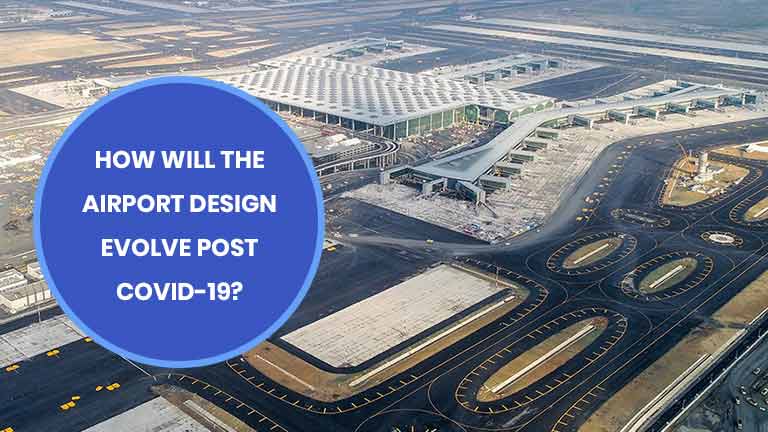
COVID-19 has left the aviation industry in a veritable tailspin, and even as air travel gradually resumes it will be completely altered. Though the aviation industry is used to disruption, the scale at which COVID-19 has affected it has been staggering. In a survey by Civil Aviation Organization by April 2020 the commercial flights worldwide had decreased by nearly 75% and there could be 2.9 billion fewer passengers in 2020 as compared to 2019. The post-pandemic world will see only a gradual rise in the number of passengers taking to the skies. With world-wide travel restrictions, shelter in place orders and widespread fear of infection most airlines are predicting that it would take mid-2022 to reach pre-pandemic levels of passengers.
Air travel in this globalized world is so integrated into commerce, leisure and international relations that its absence would alter the course of human history. People will tolerate temporary suspensions, but at some point they will eventually want to return to some semblance of normalcy. However, it won’t be completely same. There will be major changes and the most crucial change will be in the way airports are designed. Airports are enclosed public spaces with high traffic, in some of the world’s biggest airports the daily traffic movement record was around 2 Million people. In fact, some major reconfiguration will be needed to make the airports a safe place. It falls upon the construction industry and airport authorities to work in association to figure out how new social distancing guidelines and safety norms can overlay the current airport designs. The existing technologies like BIM Services, Artificial Intelligence, Biometrics, Facility Management etc. offers solutions for better and safer airport design. Below we look at three main areas of change in airport designs.
1. Smarter Airports:
The very first step most airports would want to take is to incorporate modern technology into the airports. This would include Artificial Intelligence (AI) and Biometrics to improve air quality, to maintain cleanliness of airport areas, crowd management etc. Thermal sensors can be used to measure the body temperature of people. Another way to deactivate bacteria and viruses in large areas is going to be the use of UV lighting disinfection and bipolar ionization. Moreover, most airports will try to have touchless environments which might not just be restricted to censor taps and automated doors but to more important functions like facial recognition at immigration, automated baggage drops, security checks, check-in etc. Touchless technology might also be applicable to how we order food or shop at duty free.
A lot of airports in the world had already been on the path to digitization but with COVID-19 they will have to fast-track this process. Airport management will here also greatly benefit from having as-built BIM models of the airport. Knowing where every component is located and its functional and physical aspects would lead to faster and easier to implementation of smarter technology to it.
2. Increased Space:
The current airport terminals are built for efficiency and not comfort. However, now instead of compressing as many people as possible into the terminal, the airports will also have to look at increasing in size to ensure social distancing protocols are maintained. That means waiting areas outside the departure gates, check-in counters, smoking areas, charging stations etc. will all have to increase in size. This might be challenging since a lot of airports are landlocked but architects will be looking at new ways in which airports can increase the space may it be by adding floors or creating new terminals. Not just that another challenge would be to completely redesign the place from the waiting areas at the gates to food courts everything will have to be spaced out. This might also make the concept of having outdoor spaces in airports more mainstream. Here, Architectural BIM Services can be used to gain a better understanding of the space management in existing airports and unused spaces can be converted into outdoor gardens for moments of respite and fresh air. There are already a few airports which have implemented open spaces like open-air rooftop terrace in the Frankfurt International Airport to the open air lounge overlooking the Alps in Zurich airport. The need for open fresh air and its health benefits especially for passengers on long haul flights is crucial and with people now understanding their health benefits airports might have to find ways to provide the same. Moreover, Architectural BIM can also be extremely useful in rebalancing and redesigning of terminals.
3. Infection control and wellness hubs:
9/11 changed the way airports conducted security checks similarly COVID-19 will necessitate health checks at airports. Moreover, airport management can learn and implement strategies that have been applied by healthcare facilities like using natural and durable materials, following a stringent cleaning regimen, maintaining air quality, etc. Moreover, airports might also start offering medical facilities or have doctors on-site to deal with emergency situations arising out of emergency. Another concept which might see implementation is the creation of wellness hubs which could potentially include meditation centers, yoga rooms, relaxation areas etc.
Conclusion:
In summary, COVID-19 has wreaked havoc on the aviation industry but this is short-term, what needs to be long-term are the measures that airports will have to take to ensure both physical and psychological wellbeing of the travelers even it might mean complete redesigning. It is by leveraging modern technologies that the airports be able to offer safe and contactless journeys to the passengers.