BIM Modelling Workflows That Prove Building Regulation Compliance
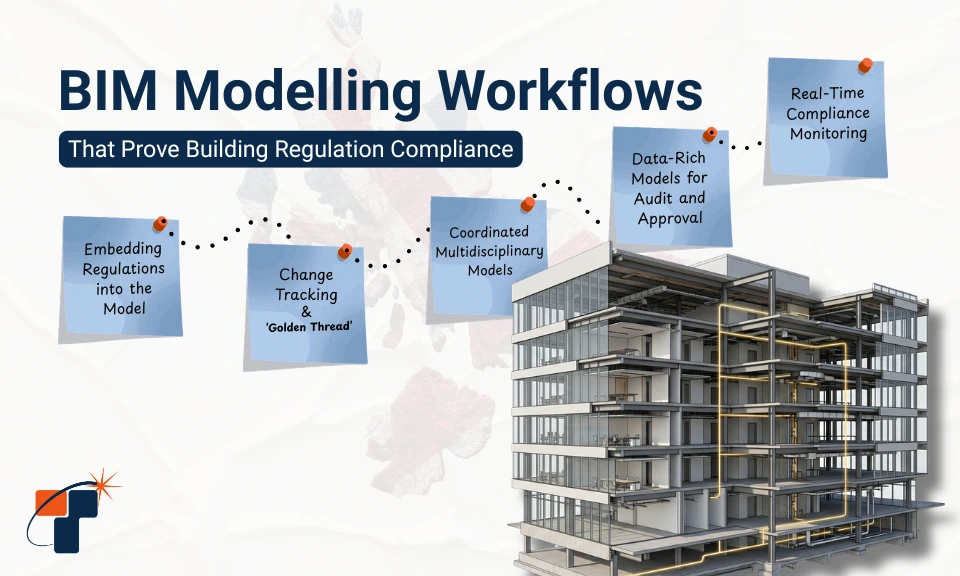
To prove that a UK project is compliant with building regulations today doesn’t just mean producing drawings: it demonstrates accountability and safety. Frameworks like the Building Safety Act 2022 are making the construction industry follow strict guidelines, along with the use of BIM Level 2 and ISO 19650 standards.
For UK architects and contractors, 3D modelling has become an essential tool to comply with these regulations. There is a clear, verifiable trail of evidence for BIM models. By 2023, BIM Level 2 was necessary for 75% of construction projects in the UK. This shows how important it is for compliance and information management.
Compliance is a continuous process powered by data inputs rather than merely a one-time checklist. We, at Tesla CAD UK, use structured BIM systems to create BIM models, which can act as a verifiable record for UK building regulations. These models also ensure safety and accuracy of the project at every stage.
3D BIM Models are central to UK Compliance
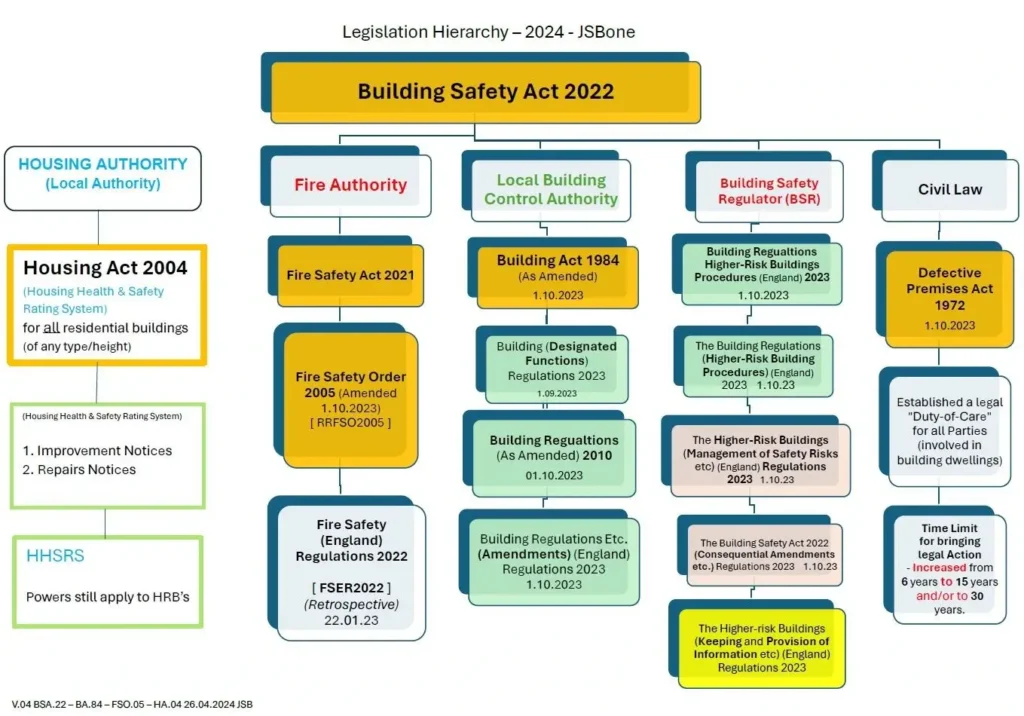
Overview of Building ACT UK – Source
Building Regulations are the statutory requirements of undertaking a construction project: to ensure safety, performance, and quality. By embedding regulatory data into the model, BIM can transform how these requirements are achieved.
BIM is ahead of 2D drawings, it serves as the single source of truth for project geometry, specifications, and all the data needed for compliance in a single environment. This enables:
- Early detection and design validation according to regulations
- Reduced non-compliance risk
- Transparent documentation for audits and approvals
With improved coordination and early clash detection, BIM can reduce the overall construction costs by 5-10%, and shorten project timelines by 7-10%.
BIM Level 2 is also mandatory for UK projects, and it needs collaborative 3D modelling and structured data exchange so that stakeholders can work with updated information. This article discusses workflows from 3D modelling that prove compliance for UK’s building regulations.
Outsource your clash detection and coordination to our specialists to prevent costly rework.
Discover Our BIM CoordinationWorkflow 1: Embedding Regulations into the Model
BIM has the powerful ability to integrate regulatory requirements directly into the 3D model. Rules like fire safety distances, access requirements, and structural constraints can be encoded directly. This means:
- The model flags non-compliant elements automatically
- During model development, designers receive instant feedback
- Compliance is proactive, not reactive
Issues like staircase headroom, incorrect fire compartmentation, and such can be identified with rule-based BIM modelling. Redesigning costs are saved, and from the first step, the project becomes compliant with UK standards.
At Tesla CAD UK, compliance is designed into the BIM model, not added later.
Workflow 2: Change Tracking and ‘Golden Thread’
The UK Building Safety Act of 2022 requires construction companies to maintain a ‘Golden Thread’ of information. This means a clear, traceable record of every design decision and change during the project’s life. Building information modelling works perfectly for this, since it can:
- Record design revisions
- Maintain model version histories
- Synchronise the updated data for all disciplines
All modifications, structural, architectural, & MEP, are tracked and validated for the project to comply with UK standards. With dedicated workflows for managing changes, we at Tesla CAD UK make sure that each update is logged, validated, and aligned. BIM also makes sure that the design intent is fulfilled in the final built asset.
Workflow 3: Coordinated Multidisciplinary Models
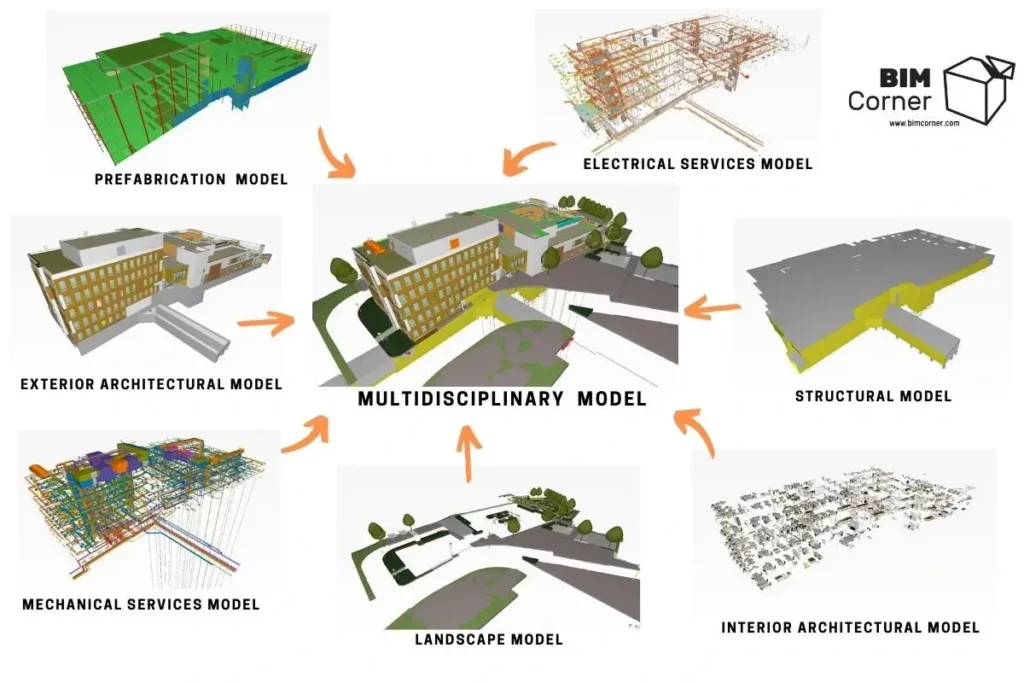
Illustrating Multidisciplinary BIM Model ©BIMCorner.com – Source
Compliance is needed for many project layers together: architects, contractors, engineers, and regulatory bodies. Through federated BIM models, BIM makes it possible: models from each discipline are combined to create a single coordinated environment. This helps the team to:
- Conduct clash detection between disciplines
- Check safety and spatial requirements
- Make sure that regulations are interpreted
Traditional workflows are non-compliant; they cause several errors and omissions. A collaborative approach significantly reduces this.
BIM also makes it easier to talk to stakeholders by using clear visuals. Contractors can see how different parts of the project work together, which lowers the chance of mistakes during installation and helps the company follow the rules.
Workflow 4: Data-Rich Models for Audit and Approval
BIM models have a great advantage of storing graphical and non-graphical data. Each element contains detailed information like:
- Materials
- Criteria for performance
- Certification data
This means that the BIM model is a compliant database, making it easier to:
- Show how it adheres to British Standards
- Act as documentation for building control approvals
- Support the asset throughout its life
By checking the integrated regulations, BIM can also help in automatic compliance. BIM will make sure that each component meets the current standards.
To help clients with compliance at every stage of the project, our models at Tesla CAD UK are structured for audits and approvals from the first day.
Workflow 5: Real-Time Compliance Monitoring
Static compliance checks no longer suffice the complex projects of today. With digital twins and integrated data systems, advanced BIM systems can now monitor compliance in real-time. They can validate designs and progress of construction constantly, with respect to regulatory requirements. If a design causes issues, it is flagged immediately.
This proactive method of working ensures:
- Alignment with regulations, constantly
- Little to no late-stage compliance failures
- Improved safety
For structural performance, fire safety, and other high-risk elements, real-time monitoring is particularly valuable. For such elements, even minor deviations cause major consequences.
Tesla CAD UK Delivers Compliance-Ready Models
Our approach goes beyond basic 3D modelling at Tesla CAD UK. Tailored to the UK regulations and systems, we build compliant BIM workflows and digital ecosystems with a deep expertise. Our services include:
- Managing information and aligning to ISO 19650 standards
- Structured CDE workflows
- For regulatory purposes, detailed LOD and LOI modelling
- Clash detection, coordination
- Audit-ready documentation
We combine technical expertise with a deep understanding of UK building standards. With over 5000 successful projects in nearly two decades, we help architects and contractors meet compliance requirements with confidence, quality, and accuracy throughout the lifecycle of the asset: with stakeholders involved at all points of time.
Visit our service page to learn how we handle structural, architectural, and MEP modeling with unmatched precision.
Browse Our BIM ServicesConclusion
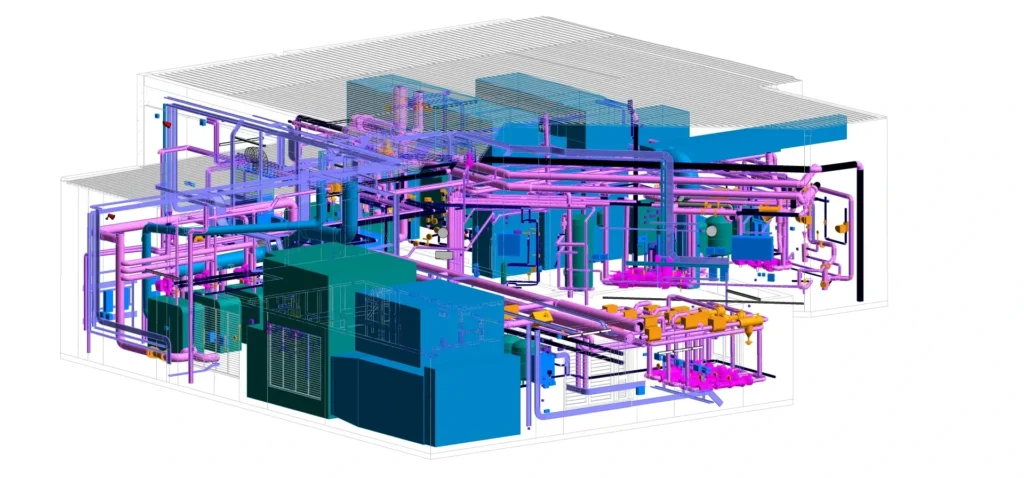
Level 2 Ready BIM Model
Compliance is not about meeting regulations any longer. For the UK construction industry, compliance means showing a project to the authorities with clarity, accuracy, and accountability. By embedding regulations into the design, BIM provides the tools to achieve a transparent, data-rich record of the project, by tracking all changes.
BIM workflows are rigorous and real-time, moving beyond rule-based modelling and coordination between disciplines. With methods like automated clash detection and performance simulation, BIM transforms compliance from being reactive into a proactive, verifiable system. BIM, and digital adoption, can increase construction productivity by 14-15%, while reducing costs significantly.
Frequently Asked Questions
How is a Common Data Environment useful for compliance?
CDE is a central platform where all project data is stored and shared from. Due to CDE, only approved & updated information is used by all the teams. This reduces risks and errors due to miscommunication or outdated drawings. CDE maintains this data and makes it ready for audits at any time.
Can BIM reduce legal risks and liability for contractors?
BIM maintains a complete digital record: design decisions, revisions, and approvals. It creates a traceable data trail which can be used in case of disputes. Contractors can use BIM data to cross-verify their work and reduce legal risks. The entire process also improves accountability for the project team.
Are high-risk projects the only ones who benefit from BIM compliance?
Large-scale, high-risk projects require BIM, but all projects can benefit from it. BIM helps in improving accuracy of drawings and construction, better coordination & documentation. UK’s regulations are constantly evolving, and adopting BIM early can help firms to stay ahead of their competitors, regardless of project scale.