
Integrating Sustainability and Carbon Tracking into the Next Era of AEC (2026 & Beyond)

In the Architecture, Engineering, and Construction (AEC) industries, for many years, BIM has been the turn of digital transformation. First, it was a coordination tool (3D), which integrated time into itself (4D), and then cost (5D). Today, at the precipice of 2026, the conversation has shifted from ‘building efficiently’ to ‘building responsibly.’
BIM is shifting into its sixth dimension, BIM 6.0, where sustainability and energy performance is embedded directly in the model. If AEC firms want to think ahead and stay competitive, they must integrate with BIM 6.0, it can help the firms understand carbon tracking, green compliance, and energy analysis. Earlier the task was project delivery, now you can shift to providing long-term value creation of the same asset (project).
According to the Autodesk State of Design & Make report, 97% of AEC organizations are now taking specific steps to improve their sustainability, with 40% of firms specifically investing in AI and digital tools to better track and optimize their environmental impact, Are you one of them?
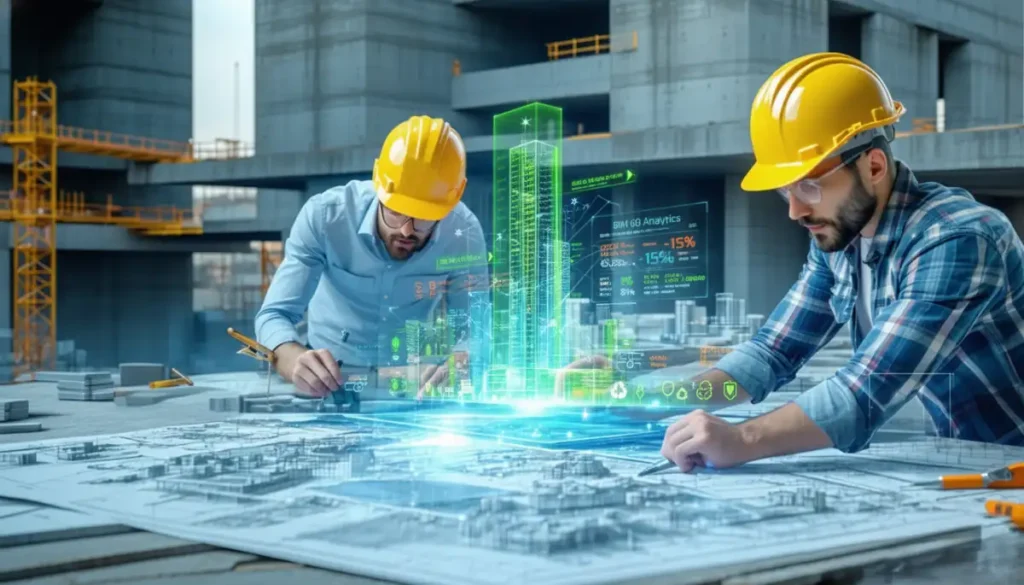
This image captures the intersection of innovation and responsibility in the AEC
Going Beyond Geometry: BIM is a Carbon Accounting Ledger
BIM 6.0 not only makes the model, but it turns this model into a living environmental dataset. Each element of this model carries environmental metadata, performance models, and real-time telemetry after it has been handed over. The speed and precision with which teams made trade-offs for time (4D) and money (5D) can now be used for carbon (6D) as well! This will help the user calculate embodied carbon – from A1 stage to A5 – continuously from the model, since the earliest schematic design stage.
Why is 2026 the Turning Point?
There are three reasons that shall bring in 2026 as the tipping point for BIM:
- Federal and institutional regulations are hardening in the UK, as are new owners’ requirements for net-zero and net-zero-ready buildings.
- Connected digital twins and IoT are rising – which closes the loop between predicted performance of the building with actual.
- Tools that convert BIM geometry into reliable lifecycle carbon and energy models have become mature.
According to the UN Environment Programme (UNEP)’s Global Status report for Buildings and Construction (2024-25), the construction of buildings and the process of operating them accounts for nearly 34% of global carbon-dioxide emissions, making it one of the largest single contributors to climate change, alongside transportation and industries—SOURCE
Carbon reporting and energy modelling outputs are now being demanded early in procurement – not as afterthoughts. In the practical world, this has now pushed sustainability into the earliest BIM deliverables – for example, the ‘Buy Clean’ regulation at state and federal levels. The model is now a single source of truth.
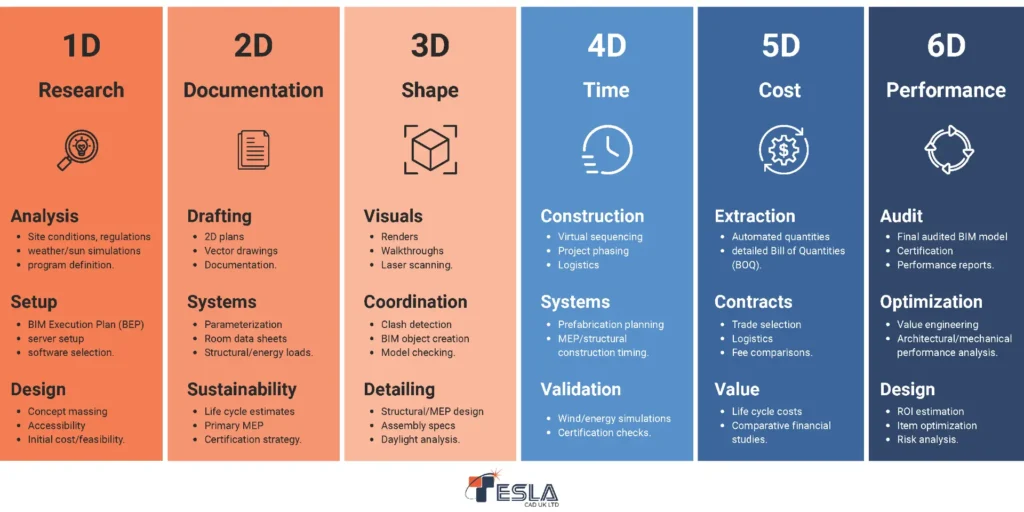
BIM Dimensions
Carbon Tracking: From Spreadsheet to Model
From manual spreadsheet calculations, the move is towards embodied carbon tools (ECAs) and BIM-linked lifecycle-assessment workflows. BIM 6.0 allows for better connectivity as well as provenance. When the material quantities in the model are linked to valid environmental product declarations (EPDs) and such similar external databases, the embodied carbon numbers become auditable too.
As for parametric models – designers can swap materials and immediately check carbon and cost implications, so that within the schematic design phase, decisions can be made – which saves the cost of expensive rework later on. Today, it is not just research or theory – BIM-based life-cycle carbon assessments have become practical, at 1:1 scale.
Energy Analysis: Design with Performance Integration in BIM
Earlier, the process was to export static geometry into a separate energy modelling tool months after the design phase – BIM 6.0 integrates high-fidelity, dynamic energy analysis into the heart of the model. The process involves merging the geometric and material data to BIM with real-time climate data, occupant behaviour algorithms, and future grid carbon intensity projections. This includes daylight studies, energy simulations, HVAC load estimates, and solar analyses within the early design iterations.
Thus, optimization cycles are shorted and more informed. The living digital twin will be able to simulate energy performances at occupancy – and also across the building’s entire lifecycle, including different climatic conditions. In 2026, efficiency will be ingrained into the building itself – with BIM, energy analysis will become a continuous, collaborative feedback loop. This process maximizes resilience – minimizing operating costs and emissions of each project.
Green Compliance is now a Deliverable, not Just a Checkbox
Earlier, designing a green building meant post-design certifications and documentation-heavy protocols. Opposite of this is BIM 6.0 – embedding compliance checks directly into the design workflow – which makes the model a pro-active, compliance model.
Within the BIM platform, these parameters are active – daylight autonomy, energy use, water usage, and indoor air quality metrics. As and when the design evolves, the BIM platform itself will provide automotive feedback: for example, changing a window size or direction means that the platform will recalculate the predicted daylight credits and the HVAC load impacts. In 2026, you can directly generate a validated report from this intelligent model to submit for green building certification. This seamless integration reduces risk, saves hours spent on manual verification, and guarantees a design intent which aligns with the certified performance.
Digital Twins & Real-time Verification: Closing the Loop
One of the key differentiators of BIM 6.0 is the operational feedback loop. The model calculates energy savings, and live IoT sensors provide current data – two of which the owners can compare. In the early stages, this feedback can help the modellers to adjust the calculations for embedded carbon baselines, adjust the operational schedules of the building, and also prioritize retrofit measures.
The Shift to Digital Twins How BIM is changing the Construction Landscape in the UK
Read NowThe integrated BIM-IoT approach can materially improve carbon & energy tracking accuracy in real-time, helping in performance guarantees. Firms can thus opt for outcome-based contracts, offering a BIM workflow that will connect the design models to post-occupancy data to become a high-value service provider.
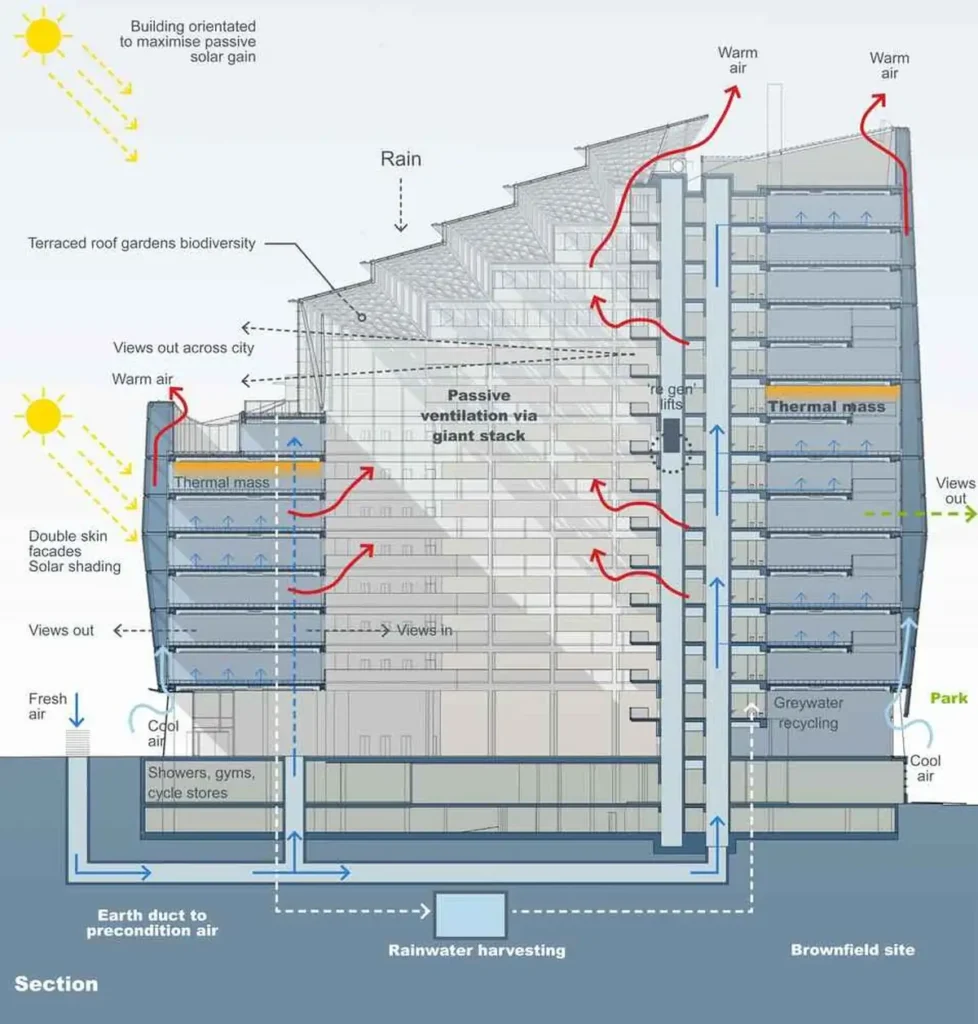
An architectural section of One Angel Square illustrating passive sustainable design, ©ArchDaily
What Firms Must do to Lead
To make your firm stand out as a pioneer in BIM 6.0 for UK AEC clients, you can focus on three primary operational shifts:
Data Governance and Standards
To keep models consistent and auditable across projects, you can you can adopt classification and metadata conventions for environmental attributes – like material codes, EPD links, and LCA mappings.
Toolchain Orchestration
You can integrate digital-twins, BIM authoring, energy simulators, and such platforms with clear file formats – this will help avoid manual transfers.
Multidisciplinary Processes
You can train the architects, engineers, estimators, and procurement teams. BIM models were being used for costing and scheduling – now, they can also be used to make sustainability decisions. And similar to the previous two, these decisions can be made as early in the design proves and as often as possible.
How BIM Outsourcing Firms can add Value
BIM adoption is no longer a question of ‘if’ – it is more about ‘when.’ In a market that is increasingly valuing health and sustainability, firms that have mastered a carbon-native approach will become leaders in the field – winning more future-oriented projects and builder deeper partnerships with their clients.
As per the UN Environment / Global ABC Global Status Report (2024-25) again, buildings consume about 32% of global final energy demand, which is why embedding energy-use modelling and energy-performance into BIM is critical.
However, building this experience in-house represents a significant investment. Outsourcing the adoption of BIM 6.0 works well for firms that lack in-house LCA experience – or even need to scale sustainability analysis on a model-basis across several projects – without long hiring cycles. With validated model enrichment, automated energy runs, parametric comparisons, and turnkey digital-twin setup for handover, outsourcing firms can provide services as a reliable replacement for in-house working – easy for owners chasing net-zero targets.
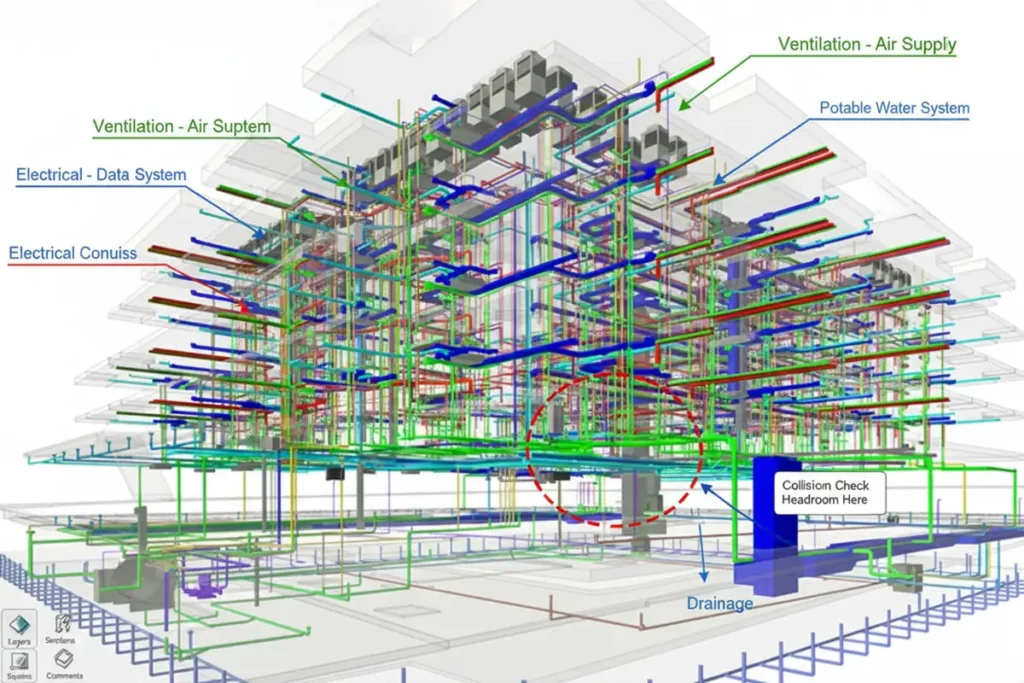
A comprehensive 3D MEP coordination model
Conclusion
Looking beyond 2026, BIM 6.0 is creating a future where the AEC industry is one of the primary drivers of sustainability in the world. The digital model of the building shall not only be a construction document – it will evolve into a dynamic, carbon-sensitive, and performance-guaranteed asset manager. Expertise will now blend BIM technological prowess with authoritative sustainability science.
The UN Environment / Global ABC status report states that in 2023, building-sector operational emissions reached close to 9.8 GtCO2, with embodied-carbon from new constructions touching almost 2.9 GtCO2. This is a direct recognition of how energy-use and material-use both need to be managed concurrently, for a meaningful decarbonisation.
AEC firms should now look at partnerships as the next step – firms that outsource specialized BIM services can act as their carbon-narrative accelerator. These firms can bring expertise, focused workflows, and dedicated resources to integrate BIM 6.0 seamlessly into your projects. Carbon calculation is now becoming a regulatory necessity, and many owners are demanding the same too – you can turn this into a competitive advantage. The next era of BIM is green and intelligent – it can build a viable, thriving, and indispensable future.
Frequently Asked Questions (FAQs)
What is the first step that a firm should take to prepare for the BIM 6.0 workflow?
You must begin with data, not with software. One of the most critical steps is to develop a digital materials library – enriched with EPD data and environmental attributes. You can partner with digitized EPDs and start assigning reliable carbon factors to your most commonly used assemblies. Simultaneously, you can initiate training which is focused on whole-life carbon principles and early-phase decision-making. This data asset and foundational knowledge will prepare the team to use the BIM 6.0 tools effectively – whenever you adopt them.
Does adopting BIM 6.0 mean that a massive investment in new software and training is necessary?
Adopting BIM 6.0 does require a strategic investment – but not a wholesale software replacement. The shift is as much about process and mindset, as it is about technology. Many of the existing platforms – like Revit and ArchiCAD – have already added carbon calculation plugins and enhanced energy modelling APIs. The investment shall happen for new workflows, maybe specialized personnel – like a carbon analyst – and for partnering with experts who can streamline the integration. The return on investment? Redesigning is reduced, projects are future-proofed against tightening regulations, and bids become sustainably-focused and high-value.
After or beyond the design process, how does BIM 6.0 help with the actual construction phase?
For precise material quantity calculation as well as waste tracking, BIM 6.0 is helpful. Based on the exact carbon budgets from the carbon-ledger model, contractors can order materials by choosing the low-carbon alternatives approved in the model. This way, they can also track the embodied carbon of the delivered materials. BIM 6.0 also facilitates ‘green commissioning’ – the as-built digital twin is calibrated with real energy meters, creating a benchmark for operational carbon tracking. This also helps prove the achieved performance, comparing it with the design intent.
With the various state-level regulations in the UK and USA, can a BIM 6.0 approach be standardized?
Yes – BIM 6.0 can be your firm’s greatest asset for adaptability. One of its core principles is configurable compliance. The intelligent model you create can be set up with rule sets for different criteria too – for example, California’s Title 24, New York’s Local Law 97, or other specific client ESG frameworks. By toggling the relevant parameters, you can make the changes without having to restart the analysis. This makes your firm agile and knowledgeable – capable of delivering compliant projects anywhere, all the while maintaining a consistent, high-performance design methodology.