
The Shift to Digital Twins Real-World Applications and Future of Construction in the UK (Part 2 – Applications, Technologies & Future)
Introduction
Part 2 adopts us into the implementation aspect of this shift in the digital. We will discuss how BIM and Digital Twins are applied to all project stages (including design and construction, as well as handover and operation) and how such technologies as IoT, AI, and cloud computing enable us to do that. By surveying them through the case studies in the UK, we will shed light on the actual effects that such inventions are already causing to infrastructure, universities, and even smart cities initiatives.
Lastly, we will also talk about the struggle that companies are going through in regards to implementing these tools, what the future of the industry is, and what workable steps companies can undertake to undertake their own digital twin implementation. Part 1 provided the “why,” and Part 2 is the “how” and “what could be next in UK construction.
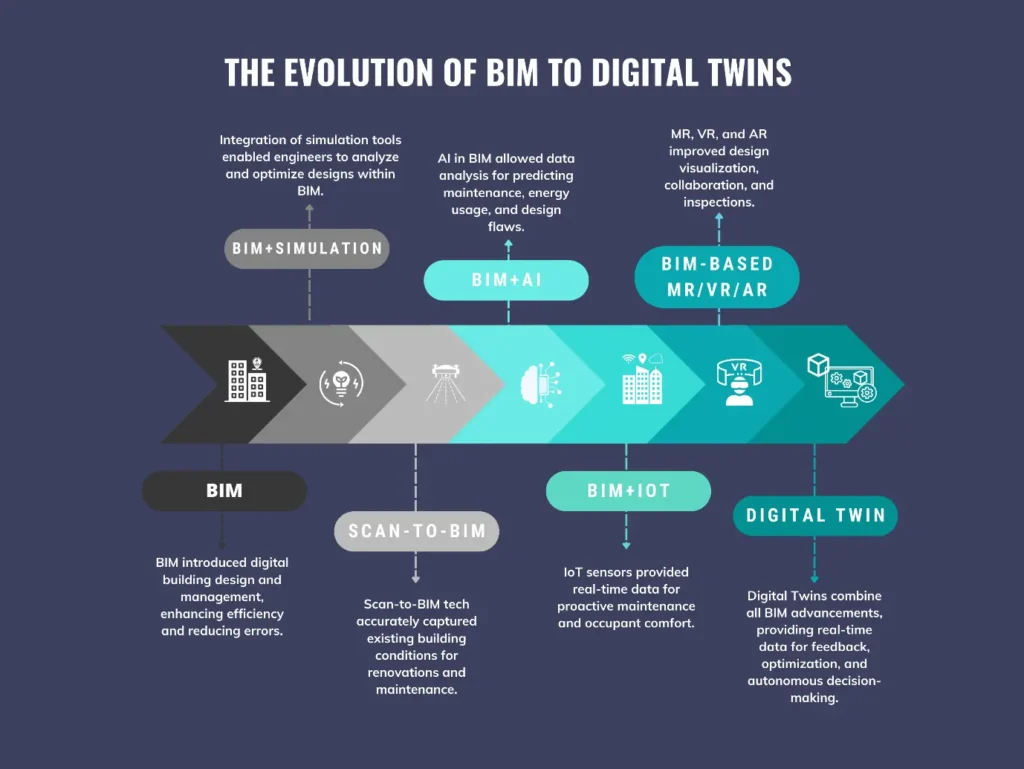
BIM to Digital Twins
How BIM and Digital Twins Work in the Real World
BIM and Digital Twins sound very advanced, but how do they function on real projects? Let us break it down into simple steps that occur during a construction project.
Stage 1: The Design Phase
- Architects and engineers create a detailed 3D BIM model of the project.
- Every component, like walls, windows, HVAC systems, lighting, and plumbing, is modeled and connected to a database.
- The model includes material properties, dimensions, costs, schedules, and performance data.
- Clash detection tools automatically identify design conflicts early.
- Energy simulation tools evaluate energy efficiency and sustainability goals.
- All stakeholders review and approve the coordinated design before construction begins.
Stage 2: The Construction Phase
- Contractors and subcontractors use the BIM model for accurate construction drawings.
- Material lists and schedules are automatically generated from the model.
- Prefabrication of components becomes possible using precise digital data.
- Site teams access the model through mobile devices for real-time instructions.
- As-built conditions are updated directly into the BIM model as work progresses.
- Digital records are created for every installed system and component.
Stage 3: The Handover Phase
- Upon completion, the BIM model is handed over to the facility owner as a digital asset.
- This model includes full documentation for operations, maintenance, and warranties.
- The BIM model now evolves into a Digital Twin by integrating live data.
Stage 4: The Operations Phase
- The Digital Twin receives real-time data from IoT sensors installed in the building.
- Building managers monitor:
- Energy consumption
- HVAC performance
- Lighting usage
- Occupancy levels
- Equipment condition
- Predictive maintenance algorithms alert managers before equipment fails.
- Simulation tools help optimize resource usage.
- All changes, repairs, and upgrades are recorded digitally for full lifecycle management.
Key Technologies
The rise of BIM and Digital Twins is made possible through a combination of powerful technologies that work together to deliver real-time insights and better control over construction projects.
Internet of Things (IoT)
- Sensors capture the live building systems.
- Track temperature, humidity, occupancy, energy usage, and equipment status.
- Feed real-time data to the Digital Twin to always monitor.
Cloud Computing
- Data storage located in one central point which can be accessed anywhere.
- Facilitates simultaneous teamwork between teams and locations.
- Massive storage of massive IoT generated data.
- Automatic back-up and safe handling of data.
Artificial Intelligence (AI) and Machine Learning
- Predictive maintenance to prevent equipment failures.
- Energy optimization based on occupancy patterns.
- Design optimization using historical project data.
- Early identification of risks and construction conflicts.
5G and High-Speed Connectivity
- Enables real-time data transmission from sensors to the Digital Twin.
- Supports mobile access to BIM models on construction sites.
- Reduces delays in communication between design, construction, and facility teams.
Augmented Reality (AR) and Virtual Reality (VR)
- AR overlays digital models onto the physical site for accurate installations.
- VR allows clients to walk through designs before construction begins.
- Improves stakeholder engagement and design approvals.
Blockchain Technology
- Creates secure, transparent records for contracts, materials, and certifications.
- Improves accountability across the supply chain.
- Reduces disputes and legal conflicts during projects.
Case Studies from the UK Construction Industry
But since we are going to discuss the real use of BIM and Digital Twins in the UK now, we shall see how they are implemented there.
Case study 1: Crossrail (Elizabeth Line), London
The use of BIM in graduating the Crossrail project was a world-renowned phenomenon of the power of BIM in the construction of mega projects, risk reduction, and enhanced coordination among thousands of subcontractor teams. The Crossrail is a European project, with one of the most complicated and largest rail infrastructure developments on the continent, with an extent of more than 100 kilometers across the city of London.
The way BIM was utilised:
- Coordinated the 3D model of tunnels, stations, and track systems.
- Interference of station layouts with underground utilities.
- Joined scheduling to control more than 40 work locations at once.
- Collected data in digital handover packages that contained comprehensive asset information to be used by maintenance personnel.
Crossrail pioneered a unified Common Data Environment (CDE) that seamlessly connected asset data, CAD models, GIS layers, documentation, scheduling, cost controls, and safety systems in one ecosystem. This integration ensured smooth lifecycle handover and maintained data consistency across the project.
Case Study 2: The Digital Twin Research at the University of Cambridge.
The project indicates that Digital Twins have a transformation potential to achieve dramatic performance improvement in buildings, energy consumption, and long-term sustainability objectives. The University of Cambridge has been at the forefront of research on Digital Twin in built environments.
Key highlights:
- Development of digital images of buildings in universities to control energy.
- Occupancy, HVAC, and lighting on demand.
- Predictive maintenance on the infrastructure within the campus.
- Acts as a testbed of the National Digital Twin Programme of the UK.
The Challenges of Adopting Digital Twins in Construction
Though there is no doubt regarding the usefulness of BIM and Digital Twins and their advantages, their implementation cannot be regarded as challenge-free. Most firms, particularly smaller firms, have challenges that hinder the speed of the digital transformation.
What are the main obstacles? Let us discuss them.
High Initial Cost, High Start-up Costs.
- The establishment of the BIM and Digital Twin system requires a high level of hardware, software, and human resources.
- The initial cost of software licenses, cloud storage, sensors, and training may be expensive.
- Such start-up expenses might be intimidating to small to mid-sized firms, though long-term savings apply.
Skills Gap
- The level of training of professionals that are needed in BIM and Digital Twin is high.
- Skilled BIM modellers, data scientists, and digital managers are in very short supply.
- Digital literacy remains a struggle, and digital upskilling is necessary in the case of many traditional construction teams.
- There is a need to learn continually since technology changes over time.
The complexity of Data Integration
- Integrating information collected by a variety of sources, such as sensors, IOT gadgets, and archives, is complicated.
- Various systems might not share compatible formats, and therefore, integration could be difficult.
- Digital Twin models may end up becoming untidy or inaccurate in the absence of proper data management strategies.
Change Resistance
- The existing professionals have become accustomed to the classic workflows on construction sites.
- It may include resistance by the management or contractors/site teams who may consider the digital processes as disruptive.
- Modification of change and effective communication play a vital role in the adoption.
Cybersecurity Risks
- Digital Twins contain a lot of sensitive data on the operations.
- A breach in cybersecurity may affect safety, privacy as well and overall business activities.
- Good security measures, encryption of data, and access control should be in place at an early stage.
Regulatory and Legal Issues
- The regulations under which the data of digital assets are handled are not fully developed.
- There are concerns about ownership of data and intellectual property rights, as well as liability for digital errors.
- The fact that one must comply with GDPR and other data protection laws makes it even more complicated.
The Future of BIM and Digital Twins in the UK Construction Industry
Despite the challenges, BIM and Digital Twins are here to stay, and their role will continue growing as the UK construction industry modernizes.
Digital Twins for construction sector
Digital Twin Programs Countrywide
- The UK government is at the forefront of global activities with the national digital twin programme (NDTp).
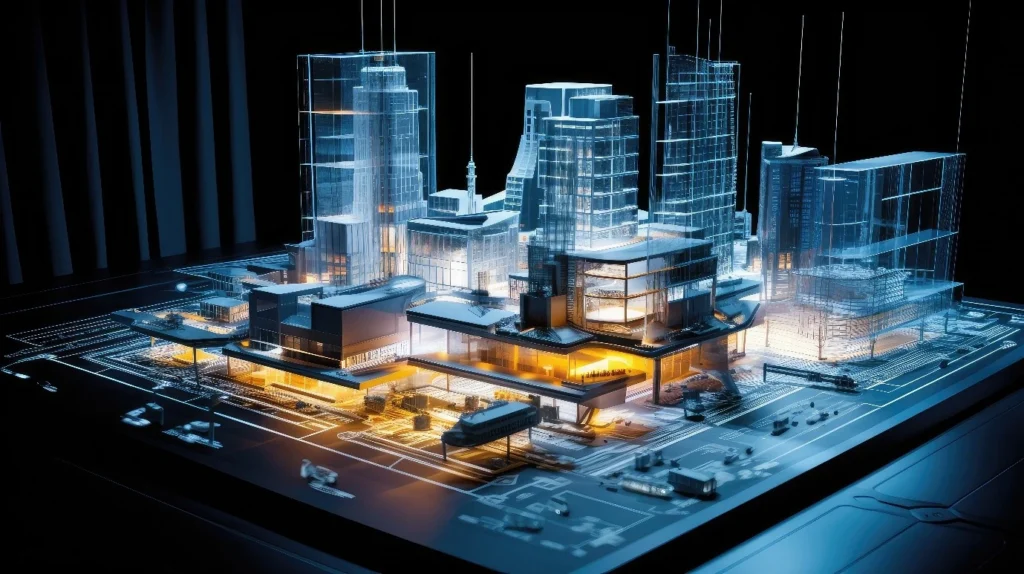
- In the long term, the vision is to develop connected Digital Twins of buildings, infrastructure, and whole cities.
- This national platform will enhance national resilience, sustainability, and sector economic efficiency.
The UK’s National Digital Twin Programme (NDTP) was launched by HM Treasury in July 2018, led by the Centre for Digital Built Britain (CDBB) and the then Department for Business, Energy, and Industrial Strateg y (BEIS). Its goal is to create an “ecosystem of connected digital twins” by developing common standards and frameworks to enable secure data sharing for improved infrastructure management.
Future Digital Twins will combine not only design and construction, but also:
- Procurement
- Manufacturing
- Logistics
- Facility management
- Dying recycling
- The full-lifecycle nature will make this more efficient in the use of resources and eliminate wasteness.
- More Artificial Intelligence ( AI )
- AI will be entwined in BIM systems and Digital Twins.
Tools powered by AI will:
- Automate optimizations of the design to better forecast the failure of equipment
- Artificially created emergencies
- Get real-time analysis of sustainability metrics
This will open the possibility of intelligent, self-optimizing buildings.
Smart cities with Digital Twins
- London, Manchester, and Birmingham are the cities that will become pioneers in the adoption of city-scale Digital Twins.
- Transportation, energy, utilities, housing, and public safety will be managed in such platforms.
- The citizens will be provided with better services, less congestion and sustainable environmental results.
Net-Zero Carbon Targets and Sustainability
- There is a growing need of advanced energy modeling in the UK due to net-zero carbon.
- Digital Twins will assist in monitoring of actual performing volumes against the design forecasts.
- The frequent observation will enable dynamic optimization of the management of energy, water, and waste.
Easy-to-use Tools of SMEs
- The further drop in the price of cloud computing means that smaller contractors and design firms will be able to access BIM and Digital Twin accessible tools at affordable rates.
- Software-as-a-Service (SaaS) business models will enable subscription instead of the previous purchase of software in large volumes.
- This will make the use of technology a democratic process in the whole supply chain.
How Companies Can Start Their Digital Twin Journey
A step-by-step method is the most effective in cases when a company wants to implement Digital Twins but is overwhelmed.
Step 1: Begin with BIM
- First, shape a robust BIM capacity.
- Training in 3D modeling, clash detection, and data-rich modeling to the design teams.
- Utilize BIM to coordinate designs, estimate cost, and utilize early stages of project management.
Step 2: Create a Data Management Plan
- Lay down specific guidelines for data storage, format, and ownership.
- Muster common data ecosystems (CDE) so that all involved parties read one point of truth.
- Develop safe cloud storage to provide BIM models.
Step 3- Connect IoT and Sensors
- Start installing IoT sensors when developing new dashes or refurbishing existing boards.
- Measure energy, occupancy, temperature, and equipment wellness in real-time.
- Make sure that data feeds relate to the BIM model to become the basis of the Digital Twin.
Step 4: Spend in Software and Partnerships
- Choose credible software services platforms of Digital Twins that are appropriate to the size and complexity of your organization.
- Collaborate with professional BIM and CAD outsourcing firms as they manage to do the data consolidation as well as modeling and system/system configuration.
- Begin with a small start, pilot Digital Twins on some of the projects and increase.
Step 5: Putting an Emphasis on Cybersecurity
- Make use of IT security professionals to construct secure systems at the onset.
- use user access controls, data encryption and data backup policies.
- Keep the security policies current with the system.
Step 6: Upskilling and Training Personnel
- Engage in permanent learning of employees at both in technical and management levels.
- Provide BIM, Digital Twins, and data management certifications.
- Foster the connection between the design, construction, and operations professionals to eliminate silos.
Role of BIM & CAD Services Companies Like Tesla CAD UK
While many companies understand the benefits of Digital Twins, few have the in-house resources to implement them fully. This is where specialized service providers like Tesla CAD UK play a vital role.
End-to-End BIM Services:
- Creation of highly detailed BIM models from architectural, structural, and MEP designs.
- Clash detection, coordination, and design optimization.
- Support across all RIBA design stages.
Digital Twin Development:
- Converting BIM models into operational Digital Twins.
- IoT sensor integration and live data connection.
- Real-time dashboards for facility managers.
Data Management Expertise:
- Setting up cloud-based Common Data Environments (CDEs).
- Secure storage, version control, and access protocols.
- Full compliance with UK data protection laws.
Lifecycle Support:
- Ongoing updates to Digital Twins as assets age and are modified.
- Predictive maintenance integration to reduce operational costs.
- Sustainability tracking to support net-zero targets.
Training and Upskilling:
- Customized BIM and Digital Twin training for client teams.
- Knowledge transfer for in-house capability building.
UK-Focused Knowledge:
- Deep understanding of UK regulations, standards, and government digital mandates.
- Proven experience across commercial, residential, infrastructure, and industrial projects.
Conclusion
The active role of BIM and Digital Twins in the UK construction industry is turning it into a much smarter, data-oriented, and environmentally conscious industry. These tools help to be more accurate, save money, and make life cycle management effective both in the design and operation. Although obstacles associated with cost, skills gap, and incompatibility of data still exist, the advantages heavily outweigh the obstacles. Firms implementing these technologies in their current operations today are better placed to be at the forefront of ensuring the future of construction, which encompasses the delivery of highly effective, resilient, and future-ready projects.
Frequently Asked Questions (FAQs)
What are the technologies behind Digital Twins in construction?
Some of the key technologies are IoT sensors, cloud computing, AI /ML, 5G connectivity, AR/VR, and blockchain in secure data management.
Which are the case studies in the UK and BIM, Digital Twins?
These may be demonstrated by the Crossrail project in London, the Digital Twin research at the University of Cambridge, and the Manchester smart infrastructure pilot.
What are the obstacles on the way to Digital Twin adoption?
The usual problems embrace high start-up costs, skills gap, complicated data integration, resistance to change, cybersecurity, and regulatory concerns.
What is the way to begin the Digital Twin process of a company?
The measures are to develop a BIM capacity, develop a data management plan, integrate IoT, select the appropriate software and partners, guarantee data security, and invest in staff development.