
The Real ROI of BIM for Contractors: Cost Savings and More

This article focuses on the main benefits of building information modeling for contractors, including cost reduction, increased efficiency, risk mitigation, and long-term project value enhancement.
Recognizing ROI in Construction
For contractors, the return on investment in construction is not only expressed in terms of the bucks spent, but it also covers:
- Tangible advantages i.e. instantaneous cost savings via fewer delays, reduced rework and optimized materials.
- Intangible benefits, like enhanced and efficient collaboration, improved client satisfaction as well as a steadfast industry reputation.
Construction projects frequently encounter unavoidable obstacles like strict deadlines, challenges of coordinating ideas across disciplines, and repeated change orders. Using BIM, contractors can easily and methodically convert possible setbacks into efficiency gains.
Cutting Costs via Reduced Rework
Rework is one of the costliest problems that the contractors face, commonly accounting for up to 30% of total project costs in some studies. Miscommunication, design conflicts, or improper installations are the main reasons for rework, and they all incur high time and cost costs.
Rework is one of the costliest problems that the contractors face, commonly accounting for up to 30% of total project costs in some studies. SOURCE
There are three key methods by which BIM helps reduce rework. Firstly, it enables the detection of conflicts i.e. clashes during the primary design phase for MEP (mechanical, electrical, plumbing) systems. Secondly, it enables the identification thereby avoidance of costly mid-project changes by identifying and resolving conflicts well in advance of the start of construction. Lastly, it optimizes communication among architects, engineers and subcontractors, to guarantee that ideas are in line from the beginning. Hence, by proactively preventing rework, contractors can stay closer to budget, maintain schedules, and enhance profitability.
Optimizing the Use of Material and Labor
Yet another significant hidden cost that is often neglected is that of material wastage. Accidents like overordering, faulty installation or underutilization of resources are common results of misinterpreting 2D drawings. By delivering precise takeoff estimates and accurate material quantities, BIM saves the day and allows for more intelligent resource management.
Contractors observe 3 main benefits, namely:
- Lower material costs through controlled ordering.
- Curbed on-site waste, cutting disposal costs.
- Better labor planning with detailed and optimized scheduling as well as resource allocation.
These efficiencies enable teams to better allocate resources and increase profit margins, boosting project performance overall.
Accelerating Project Delivery
Long before actual work commences, contractors can perceive the project timeline via BIM’s time scheduling feature, which allows them to view construction stages in all four dimensions. This predictability streamlines team coordination and quickens project delivery, thereby lowering overhead costs and driving customer relationships. Furthermore, it assists in the recognition of bottlenecks and elimination of workflow interruptions.
A fast and efficient project delivery creates loyal customers that provide repeat business as well as saves money, both of which allows the contractor to establish a rock-solid reputation and strong foothold in the industry.
Leveraging BIM for Better Stakeholder Communication
Not all stakeholders possess necessarily technically proficiency. BIM therefore allows for bridging of the resulting communication gap by simplifying correspondence. Gone are the days of relying on misinterpretations of 2D drawings or monotonous reports because now clients, investors and authorities can use BIM to simply visualize detailed 3D models of the project. The resulting clarity helps mitigate misunderstandings, accelerate sanctioning and foster trust between the contractors and stakeholders.
This visually appealing way of presenting data using BIM makes ensures early-on conformity of expectations, thereby minimizing costly disputes in later stages. Therefore, such clear communication ultimately results into seamless decision-making, quicker buy-ins, and stronger long-term relationships, that directly contribute to improved ROI.
Curbing Risk Potential and Enhancing Safety
Undeniably, construction carries substantial risks. BIM assists contractors in anticipating and reducing risks before they materialize. A comprehensive view of the site and systems is provided by BIM models, enabling preventive planning and safety risk simulation as well as early detection of possible problems with installation or design, not to mention adherence to legal requirements, lowering legal risk.
Improved safety compliance and fewer accidents result in lower costs and a more dependable workplace.
The prime cost-saving advantage of BIM is Clash detection and reduced rework. Early spotting and elimination of design conflicts helps dodge costly and inconvenient mid-project changes.
Long-Term ROI plus Strategic Benefits
Alongside immediate cost savings, BIM provides 3 principal long-term strategic benefits:
- Contractors are projected as creative industry leaders who are in greater demand for major projects
- Government implemented BIM requirements for public projects are fulfilled.
- Proactive planning is enforced for upcoming maintenance, remodeling, or expansion projects.
Apart from saving money in real time, contractors who use BIM gain a competitive edge in the market and harbor long-term growth prospects.
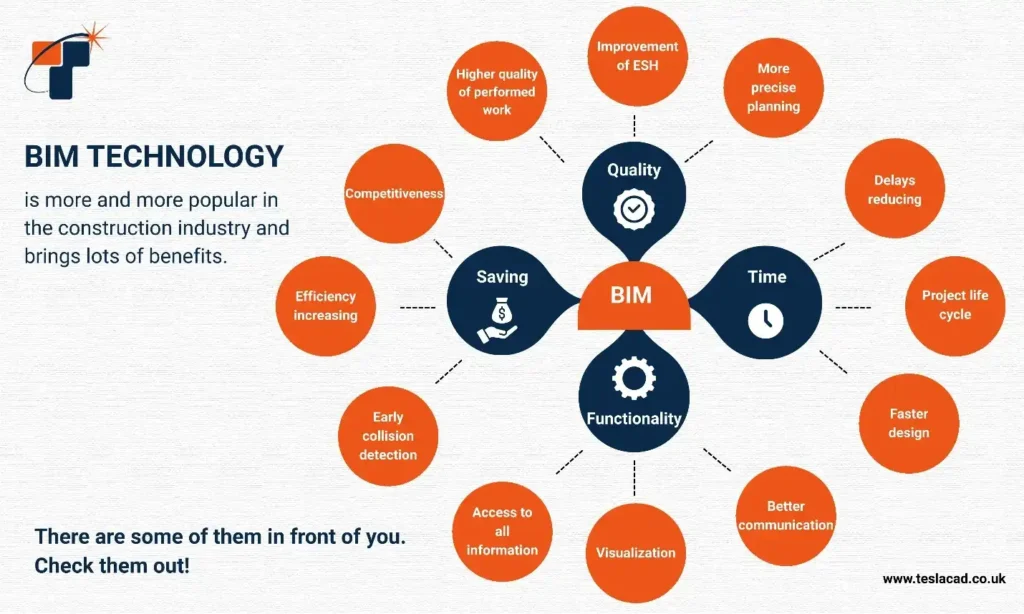
BIM Technology in Construction Industry
Humanizing the ROI
ROI isn’t only about numbers; it’s also about people. BIM curtails stress, trims down miscommunication, and fosters collaboration. Imagine a project manager who has prompt access to all project data, or a subcontractor who can see exactly where their work fits in the overall schedule.
These advantages result in smooth team dynamics and collaboration, increased productivity and pride in one’s work, and far enhanced client relationships than ever before through transparency. In the end, BIM gives contractors the inspiration to show their clients their best work with the fewest challenges and increased satisfaction for all parties involved.

FAQs
Is BIM only suitable for large corporate construction firms?
Absolutely not. While larger companies were early adopters, BIM solutions with scalable tools for varying project sizes and budgets are now easily and cost-effectively accessible to small and mid-sized contractors as well.
What is the prime cost-saving advantage of BIM?
Clash detection and reduced rework top the list of most significant cost-saving factors. Early spotting and elimination of design conflicts helps dodge costly and inconvenient mid-project changes.
How does BIM help boost client satisfaction?
BIM allows for visualization and transparency, enabling clients to visualize accurate models and estimated outcomes far in advance. This reduces surprises, builds trust, and inspires repeat business.
Are there benefits of BIM in addition from cost savings?
Indeed. Collaboration, safety, compliance, eligibility for BIM-mandated projects, along with reputation for innovation are all enhanced by BIM and all these factors support long-term company growth.