
Why Your BIM Strategy Needs a ‘Soft Landing’ Framework
In the last decade, the UK Architecture, Engineering, and Construction (AEC) Industry has made great strides in adopting BIM for their projects. What started from coordinated 3D models moves to 4D construction sequencing (time) and also 5D cost management – BIM has now become an integral part of project delivery. However, this maturity still faces a persistent problem – there is a disconnect between the design & construction teams, with the team that actually operates, manages, and maintains these built projects.
More often than not, BIM models are handed over at completion – and these are static, complex datasets that the on-site facility managers struggle to use, which may cause them to ignore it completely as well. The result? A missed opportunity. If your BIM model cannot support the operations of the project, it no longer is an asset – it becomes a sunk cost.
This is the place where Government Soft Landings (GSL) framework becomes critical – GSL isn’t an add on, but a missing strategic layer which ensures that BIM will deliver long-time value. BIM Managers are responsible for outcomes even after handover – and GSL is a structured way to bridge the gap between BIM capital delivery (construction) and operational performance (running).
The Design-to-Operations Gap: BIM’s Weakest Link
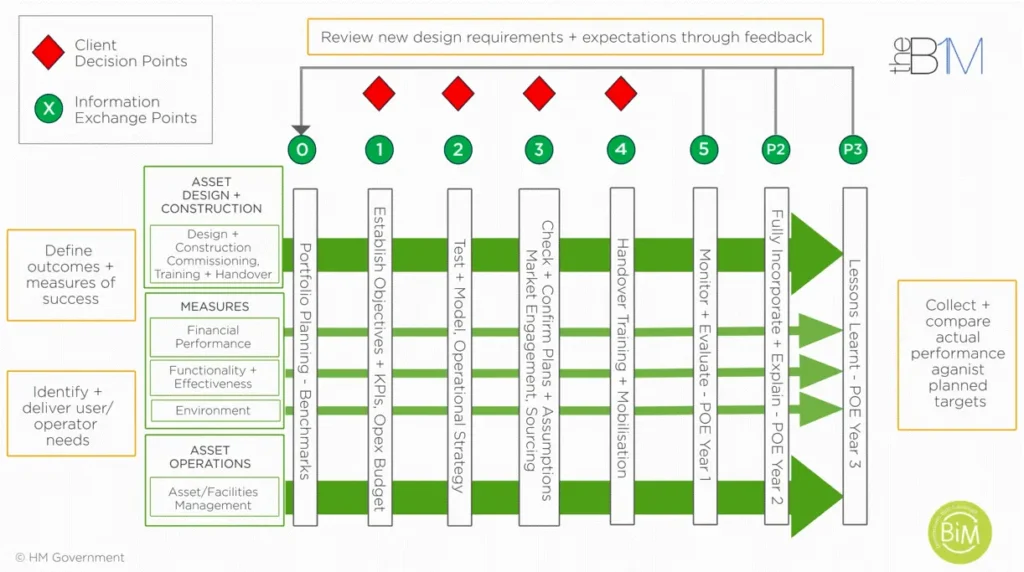
Design Review and Feedback Expectations ©the B1M
Even when there are well developed Employer’s Information Requirements (EIRs) of the project, and BIM models are getting extensively sophisticated, there remains one prominent systemic issue throughout all projects – BIM is being produced for compliance, not for use. Some of the common symptoms can include:
- Data of the asset doesn’t align with facility management systems
- The BIM model is overloaded with unnecessary geometry but it does not have operational attributes
- Facilities management teams became involved late
- The handover information was delivered too late or in formats which were unusable
This gives birth to chaos – once the building is occupied, the operators shift to PDFs, spreadsheets, and legacy CAFM processes. The BIM model – which was developed with a lot of effort and detail over the years – sits on a shelf, unused.
The issue is not modelling capacity – it is a strategic failure, not a technical one for BIM Managers. Since the beginning, BIM modelling has not focused on developing a framework which is focused on the lifestyle of the users of the projects – it does not prioritise the operational outcomes of the building.
What Is Government Soft Landings (GSL)?
GSL – Government Soft Landings – is a UK government-mandated framework which was originally introduced to improve the performances of public-sector buildings. the primary objective of GSL is simple yet powerful: making sure that buildings meet the needs of the users and operators throughout their lifecycles – not just at the handover.
GSL restructures how teams think about project success – completion is not the end goal now, Soft Landings extends accountability into early operations too, which is usually up to three years after handover. Some of the key principles of GSL are:
- Defining performance outcomes early on
- Constant involvement of end users as well as FM teams – all stakeholders
- Gradual and supported handover
- Evaluation at post-occupancy stage and eventual feedback loops
- Constant and growing thread of information
When GSL is integrated, BIM moves on from being a design deliverable to becoming a service to operations of the project.
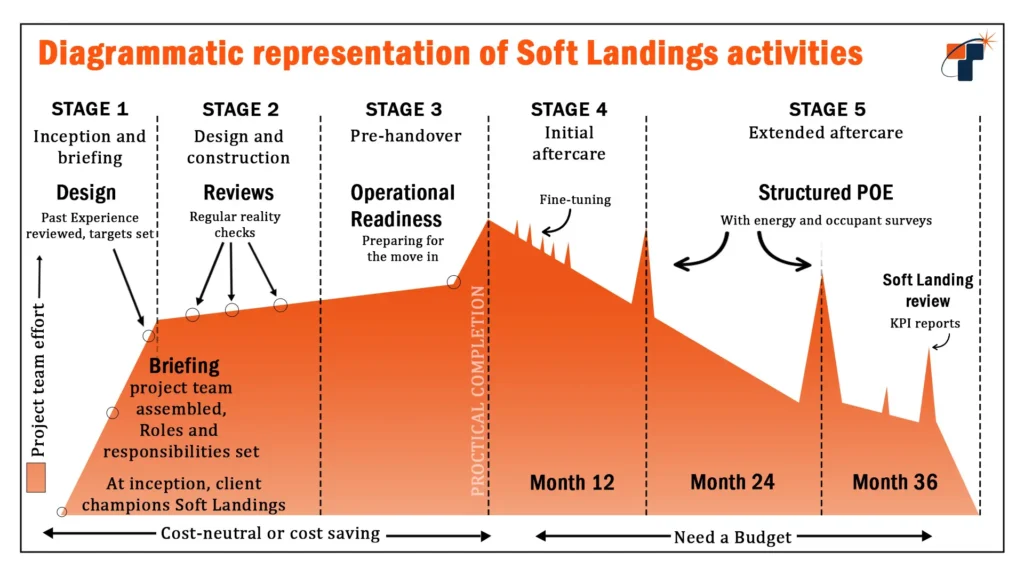
Diagrammatic Representation of Soft Landings Activities
Why Do BIM Projects without Soft Landings Falls Short
When you choose a BIM strategy, it usually focuses on:
- Authoring standards for BIM models
- Clash avoidance
- Data Schemas
- And compliance with ISO 19650
These are all essential – but they do not guarantee that the final output of the BIM modelling shall be operationally useful. Working further without a Soft Landings approach can lead to:
- Information details of the asset being defined too late
- COBie being treated as a contractual checkbox
- FM teams just working with whatever data they receive
- Knowledge transfer being rushed or even non-existent
All in all, it creates a BIM model that cannot be interrogated, updated, or trusted by facility managers – something which has no operational value. When GSL is introduced, BIM requirements are influenced by how the building will be run – not just how it will be built.
Over 70% of projects do not deliver a 3D model or a COBie dataset to the client at the end of the project – which means crucial asset information will not reach facility managers in a structured, usable way—SOURCE
Soft Landings – the Missing BIM Governance Layer
As a BIM Manager, Soft Landings is a governance framework – which will sit above BIM execution plans and the delivery milestones for information. If GSL is aligned with BIM, it easily enables:
- A clear transition from objectives at an organizational level to information requirements
- Validation of the asset data during design and then construction – progressive validation
- Structured workshops of soft landings at strategic stages of the project
- A transition from construction data to operational data which is managed
When this alignment occurs, BIM deliverables easily evolve in sync with the operational needs of the project – rather than adapted at the handover stage retrospectively.
In a survey conducted with facility management professionals focused in the UK, 83% stated that BIM will help support FM delivery while adding significant value, while 81% professionals agreed that the organisations adopting BIM could gain competitive advantage – and yet, the awareness and experience remain low.
BIM Outsourcing in a Soft Landings Strategy
BIM outsourcing partner’s roles extend much beyond just model production – we can support the client by embedding Soft Landings into the project’s BIM workflows – particularly in the places where internal teams are overworked or siloed. Some typical areas of support included in this are:
- Translating the needs of FM and asset management into clear AIRs
- Structuring the BIM models and its data for CAFM and IWMS integration
- Managing the release of data aligned with the Soft Landings stages
- Ensuring that asset information is consistent and usable
- Supporting the validation of data and optimization after handover is complete
When done strategically, outsourcing can help BIM Managers to focus on leadership duties and project outcomes – while specialist teams will ensure that the information quality and structure are maintained throughout the lifecycle of the project.
In a UK facilities management survey, it was noted that only 39.8% of the correspondents had experience in bring involved in a BIM project, while only 20% had direct experience in writing or implementing an Asset Management strategy using BIM data – which highlights the operational disconnect in the industry.
Soft Landings in Practice: A Cultural Shift in BIM Delivery
Implementing GSL isn’t just about the process – it needs a cultural shift in the BIM delivery process. Teams doing the design and the construction work should understand that the success of a building is measured by the performance of the building while it is being used – not just by timely delivery within budget. For BIM Managers, this involves new steps like:
- Advocating for early and often engagement & collaboration of facilities manager(s)
- Educating the clients about GSL
- Challenging the unnecessary complex modelling in BIM
- Revising BIM Execution Plan templates
- Prioritising the usability of data above the theoretical completeness of the same data
- Measuring the success of BIM through operational KPIs
This shift also aligns with UK’s AEC industry – which is moving towards an outcome-based delivery of BIM, focused on net-zero performances and whole-life value of the model.
Why Soft Landings Matters More Than Ever in 2026
For the construction sector of UK, there is increasing pressure for sustainability, operational efficiency, and digital transformation. Thus, it is true that the importance of building data – which is usable – will only grow.
ESG reporting, expectations in a regulatory sense, and carbon performance targets – they all depend on the presence of accurate, accessible, operational BIM data. To make BIM a powerful enabler, rather than a dormant asset – pair it with a Soft Landings framework.
When organizations invest heavily in digital construction, their priority is no longer having a BIM model – it is if their operators will be able to use these models on day one.
The industry reports state that 73% of UK construction professionals have reported to using BIM on their projects – which means that there is strong design and construction-based adoption of BIM, but it is not being used as much in operations.
Conclusion
BIM delivers the tools and the data – but a BIM strategy without a Soft Landings framework is incomplete. Government Soft Landings provide accountability and structure, as well as the lifecycle focus needed to turn the data into something of real operational value.
For BIM Managers, GSL is an opportunity for leadership – not just a compliance requirement. GSL will help you make BIM a long-term asset, which aligns the project teams to work around user outcomes, and ensures that the effort invested during design & construction – digitally – pays dividends during working.
In the end, the success of a building is measured by how well it performs once it is occupied – Soft Landings ensures that that the BIM strategy you choose is designed not only to deliver buildings, but to actually make them work efficiently.

Frequently Asked Questions (FAQs)
Isn’t it true that GSL is only adding more cost and responsibility for the design and the construction team?
GSL actually requires a shift in resource allocation in the beginning – involving FM early does take time, but it is an investment which mitigates lots of other costs. You can reduce the risk, avoid costly call-backs, and enhance your reputation by catching operational issues during design (like selecting maintainable equipment and ensuring safe access) and reducing the traditional defects & snagging period through structured aftercare. For the client, the minimal upfront cost is nothing compared to the long-term operational savings. From a capital expenditure (CAPEX), the cost is transformed into an operational expenditure (OPEX) solution.
How is GSL any different from the traditional handovers, with O&M manuals and a BIM model?
At the time of completion, a traditional handover is mostly one-way and document-centric. GSL, on the other hand, is a continuous process focused on outcomes that run from project inception to three years post-occupancy. The major differences are:
- Active FM Involvement – FM is a consultant from the first stage, not at the end
- Performance Measurement – soft landing outcomes can be defined and tracked, like energy use and occupant comfort
- Aftercare – the project team remains involved to educate the users and fine-tune the systems.
The BIM model, in such a case, is a living tool – not just a static deliverable.
How does GSL integrate with our existing BIM workflows and ISO 19650?
GSL integrates seamless with existing BIM workflows – it provides the ‘why’ and the operational outcomes – while ISO 19650 provides the ‘how’ for information management. The Employer’s Information Requirements (EIRs) can be drawn through GSL outcomes and the FM team’s data needs. The Asset Information Model – AIM – which is required by ISO 19650 is a deliverable that GSL can validate and fulfil too. Consider this – GSL is a strategic layer that ensures that your ISO 19650-compliant processes will deliver proper, useful information.
How do we convince our clients, who are not asking for GSL, that it is valuable?
You can frame the value of GSL according to their risks and returns. You can also talk about the Building Safety Act, the Golden Thread, and the liability of handing over an unusable digital asset. The potential of their building can also be quantified:
- Would it be valuable if there is a 5 to 10% reduction in your building’s energy use from day one?
- What if we can reduce your maintenance call-out costs by giving your team immediate, intuitive access to all asset data?
Show that GSL is not an additional service – it is a smarter, de-risked way of achieving core business operatives for the client from their built asset. You can offer a small, pilot workshop on GSL’s benefits also, as an effective first step.