
The Advantages of Point Cloud to BIM Modelling in Building Renovation
Introduction
Building renovation is an important process in the construction industry, as it allows for the revitalization and enhancement of existing structures. With technological advancements, the integration of point cloud data and BIM Services has emerged as a game-changer in the field of renovation. A point cloud is the collection of precise 3D data points obtained through laser scanning technology and offers a detailed representation of the physical characteristics of buildings. On the other hand, virtual construction serves as a powerful digital tool for planning, designing, and managing building projects. The conversion of point cloud data into information-rich digital models is called scan to BIM.
In this blog, we will explore the advantages of using laser scanning to BIM conversion in building renovation. This powerful synergy enables professionals to create accurate as-built documentation, visualise renovations in immersive 3D environments, and detect potential clashes and conflicts before they occur. Moreover, the integration leads to substantial time and cost savings, eliminating the need for extensive field surveys and manual measurements.
Furthermore, collaboration between various stakeholders improves, fostering well-informed decision-making for successful renovation projects. Through real-life examples and case studies, we will delve into how this innovative approach revolutionises the way we approach building renovation, ultimately delivering more efficient, precise, and sustainable outcomes.
What is Point Cloud Data?
Point cloud data is a collection of precise 3D data points that represent the physical surfaces and characteristics of objects within a defined space, such as a building or a room. These data points are acquired through advanced technologies like laser scanning.
Related Blog: What is Point Cloud to BIM and why is it important for Renovation projects?
Laser scanning technology utilises laser beams to measure distances and create a dense network of points, capturing the geometry and spatial details of the environment. The scanner rotates and emits laser pulses, measuring the time it takes for the beam to bounce back, thus calculating the distance to objects. As a result, millions of points are generated, forming a “cloud” of data that offers an accurate representation of the scanned area.
Scan to BIM Conversion
The scan data is then converted to a BIM model with the help of software such as Autodesk Recap and Autodesk Revit. Point Cloud to BIM Service is, thus, an efficient tool that can enhance the accuracy and efficiency of renovation projects by converting the data into digital construction models with precise as-built information, eliminating the need for manual measurements. This synergy also enables seamless clash detection, minimising errors and conflicts during the planning phase. The result is a comprehensive and reliable digital twin of the existing structure, laying a strong foundation for informed decision-making, improved collaboration, and successful building renovation endeavours.
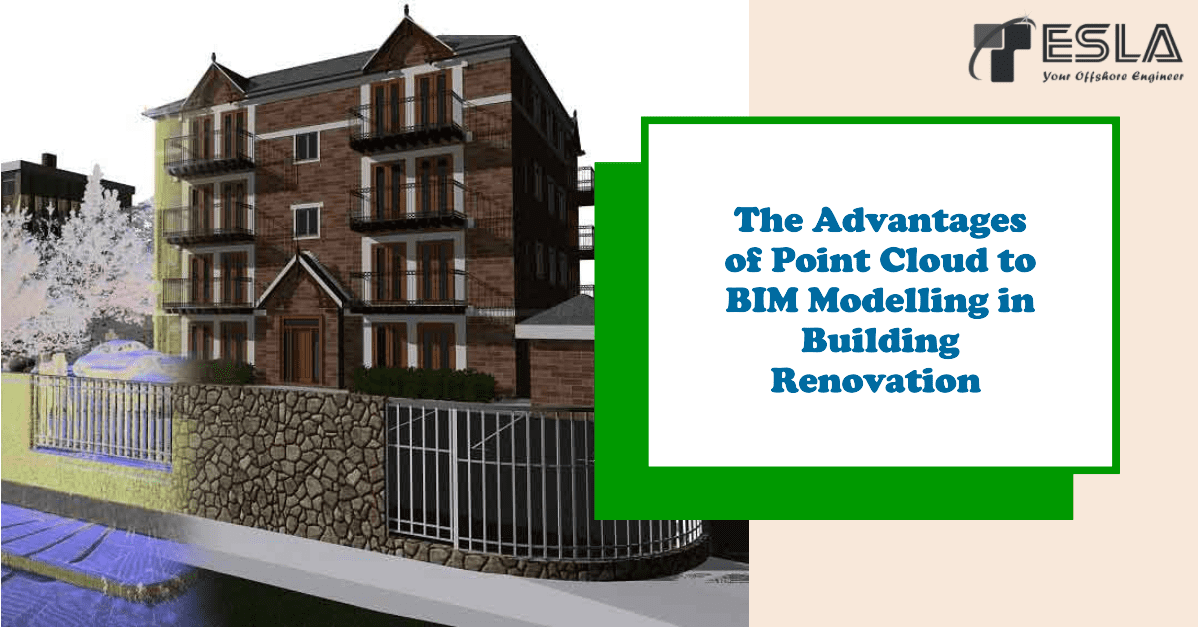
Case Study: Scan to Revit Modelling for a Public Townhall
Advantages of Point Cloud to BIM Modelling in Building Renovation
- Accurate As-Built Documentation: Laser scanned data provides a highly precise representation of existing structures, capturing intricate details that might be missed during manual surveys. When integrated with virtual construction software, it creates comprehensive as-built documentation, aiding architects and engineers in making informed renovation decisions based on real-world conditions.
- Cost Estimation and Cost Savings: The combination of point cloud and VDC facilitates precise cost estimation for building renovations. By having detailed 3D information about the existing structure, project teams can accurately assess the materials, quantities, and labour required for the renovation. This leads to better cost control and potential savings by identifying efficient solutions and avoiding costly design modifications during the construction phase.
- Streamlined Clash Detection and Resolution: By using laser scanning, professionals can identify clashes and conflicts between new designs and existing structures. Early detection of such issues helps prevent costly mistakes during the construction phase, streamlining the renovation process and reducing potential delays.
- Improved Collaboration and Communication: BIM models created using scanned data facilitate effective communication among project teams. The visual richness and accuracy of the digital model enhances the collaboration between architects, engineers, contractors, and clients. This shared understanding reduces misunderstandings and ensures a smoother renovation process with a higher likelihood of successful project completion.
Conclusion
In conclusion, the synergistic integration of point cloud data and BIM has undeniably revolutionised the building renovation sector, offering a host of remarkable advantages. The precise and detailed representation of existing structures empowers professionals to make well-informed decisions and plan renovations with unparalleled accuracy.
Looking ahead, the outlook for this process is incredibly promising. As technological advancements continue to emerge, we can expect even greater automation and optimisation in the renovation process. Moreover, the integration of artificial intelligence (AI) and machine learning (ML) into these technologies may enable real-time analysis, predictive modelling, and further improvements in sustainability.
Undoubtedly, scan to BIM modelling will continue to be a game-changer in the building renovation domain, empowering professionals to create more resilient, efficient, and eco-friendly structures that meet the evolving needs of our dynamic world.