Creating Sustainable Cities: Reducing Urban Heat Through Design
As these days have recorded an odd heat wave over many cities, much noise is being made over an expected UHI effect in the world’s hotspots. Hot spots in all towns and downtowns simply mean that they may absorb and hold more heat than nearby rural areas, with some cities being much, much warmer, sometimes spikes of a few degrees, especially in summer months.
In the UK and US, this issue remains more potent with the heat generation spikes arising from the urban densities, aging infrastructural systems, and the climes themselves. From the sizzling hot roads of NYC to late-coming summer heatwaves mussing London, urban heat is no longer some distant thought. It is a real-time challenge with all dimensions of health, energy, and social equity.
But from the positive side, the design and shaping of cities can work against this. This blog is about how sustainable urban design is cooling cities down one block at a time. So, let us first understand what heats our cities and what can be done about it.
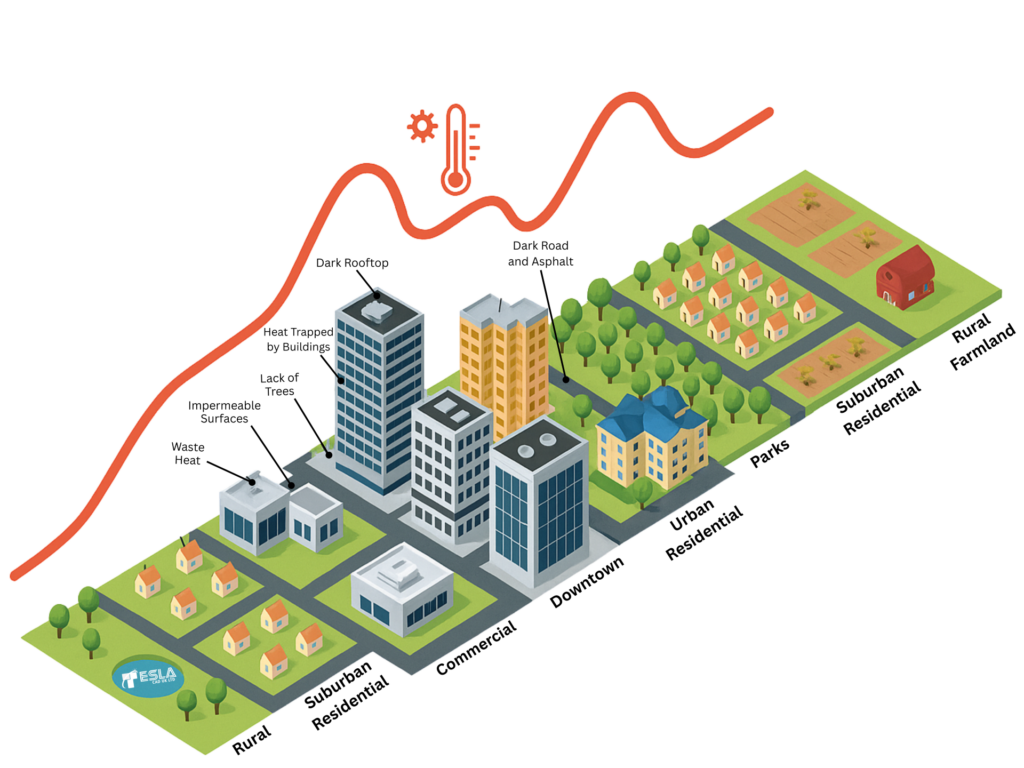
Urban Heat Island Effect
Source: https://www.moodys.com/web/en/us/insights/resources/insights-into-urban-heat-mitigation.pdf
What is Heating Our Cities?
Cities heat up more than rural areas because it’s all about what they are made of and their design.
- Materials like Concrete, asphalt, and steel absorb heat throughout the day and release it during the night, which keeps urban areas warmer.
- Buildings and pavements heat up and absorb the sun, while trees and lawns cool the air through shade and evaporation.
- Cars, air conditioning units, and industry all contribute their waste heat during the warm season.
London’s Urban Heat Problem
London is well-acquainted with the UHI effect. Research indicates that during periods of peak summer heat, selected areas around the city exceed even hotter temperatures because of UHI by 10°C (18°F) in some places. Not only does this make for uncomfortable days and nights, but this UHI also increases energy demand as people make use of fans or air conditioning. In terms of health, the increased heat can lead to spikes in hospital admissions caused by heat waves in London, particularly among vulnerable populations.

London’s Extreme Urban Heat Island
Source: https://issuu.com/landscape-institute/docs/13288_li_journal_4_2023_v9_issuu/s/44999298
New York City’s Sweltering Summers
New York City has the same issues as the US. The Heat Vulnerability Index shows that some places, mainly with less green space and lower-income groups, suffer from extreme heat more than others.
In both cities, dense urban environments, outdated infrastructure, and a lack of green space all combine to turn up the thermostat.
Cooling with Nature: Green Infrastructure
If concrete and asphalt are used, then Mother Nature is the real hero. To our air conditioning system for the city, green infrastructures as parks, green roofs, and street trees-serve as an efficient natural air conditioner.
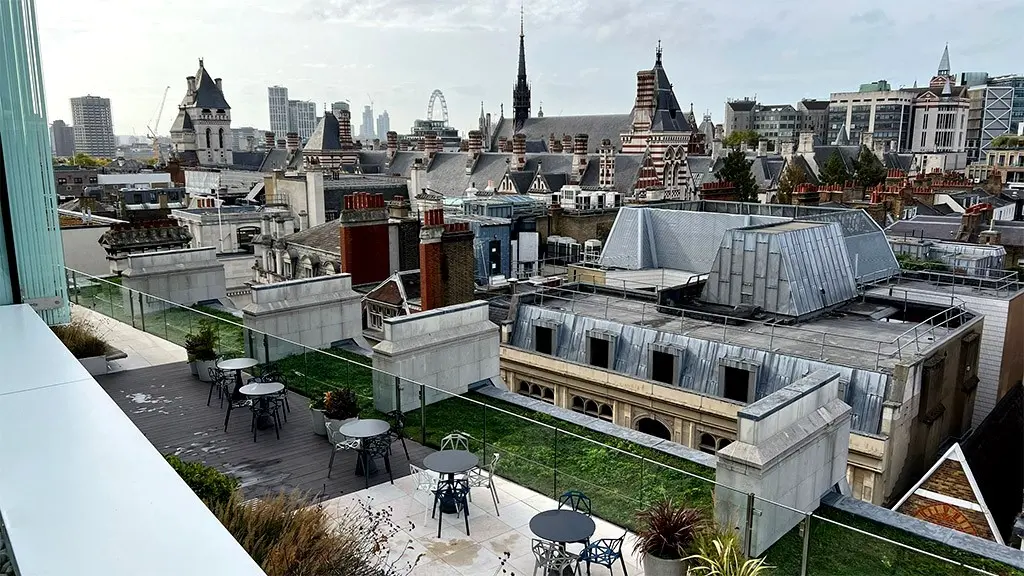
London’s Green Roof Boom
At present, London is solely focused on green roofs. The city, covering more than 1.5 million square meters, has a great collection of green roofing systems. Green roofs are great at insulating buildings, cooling the air around buildings, dealing with stormwater runoff, and supporting biodiversity.
London’s Green Roof Boom
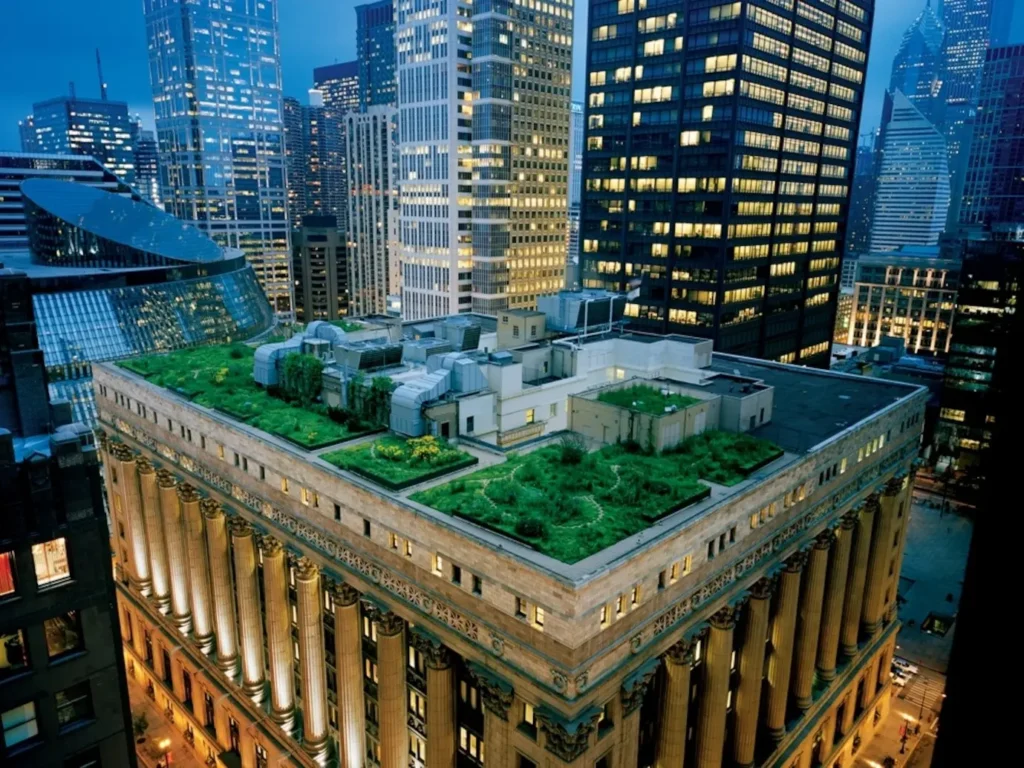
Chicago’s City Hall
Among the rooftop gardens of the US, one of the most well-known is Chicago’s City Hall roof. Installed in 2000, it has more than 20000 plants and has become a model in many urban greening projects around the rest of the country. Studies indicate that the roof could become up to 14°F (7.8°C) cooler than conventional roofs during a very hot day.
Chicago City Hall
Source: https://www.nationalgeographic.com/photo-of-the-day/photo/chicago-city-hall-cook-jenshel
Million Trees NYC
An ambitious Million Trees NYC program initiated in 2007 in New York City aimed to plant one million new trees across the city, just as the words suggest. The trees provide shade, reduce surface temperatures, and create more pleasant urban spaces. The program met its target in 2015, and today those trees form an important cooling component for the city.
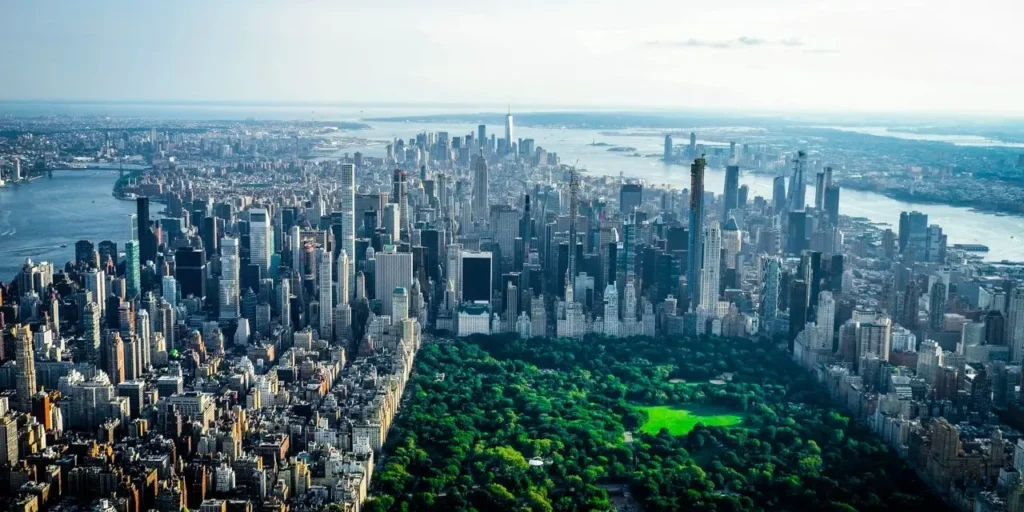
Million Trees NYC
London’s Tree Planting Efforts
London has been expanding its urban forest, aiming to increase tree canopy cover to at least 33% by 2050. With over 8 million trees already shading the city, every new planting helps reduce heat and improve air quality.
Parks and Open Spaces
One of the most creative green spaces in New York City, the High Line transformed an old elevated railway into a lush, linear park. This unique urban oasis not only cools the immediate area but also offers a much-needed escape from the heat for residents and visitors alike.
London’s mini-parks scattered throughout the city may be small in scale, but they transform what were once underutilized pockets of land into green spaces that add significant value to communities. Individually, these parklets may not seem impactful, but collectively, they help cool local areas while enhancing community wellbeing.
Fighting Heat with Cool Materials
Cool Roofs Reflecting Heat
A dark roof is like a heat sponge. Now think of trading it for a reflective “cool” surface that reflects sunlight to the atmosphere. This is what a cool roof is.
- New York City started a Cool Roofs Program in 2009 for coating roughly 10 million square feet of urban rooftops with reflective materials, allowing some rooftops to reduce their rooftop temperatures by 30%.
- In the UK by the London Building Research Establishment (BRE) is currently performing ongoing studies with reflective materials, as well as in new construction or retrofitting some commercial buildings with cool roof designs to significantly reduce cooling costs and reduce urban heat.
High-Albedo Pavements
Pavements and roads make up a huge chunk of urban surfaces, and they get hot. High-albedo (highly reflective) pavements are engineered to stay cooler by reflecting more sunlight.
- LA has been a pioneer, testing reflective coatings on streets that can reduce surface temperatures by up to 10°F (5.5°C).
- London’s Transport for London (TfL) has been exploring reflective asphalt in select areas to counteract heat build-up, especially during prolonged heat waves.
Cool Walls and Facades
Cool walls and facades use similar technology of reflective paints and materials that prevent buildings from overheating. This is especially useful for older buildings in historic cities like London, where retrofitting can make a big difference.
A Quick Snapshot
In a study comparing building temperatures in NYC, it was found that buildings with cool facades could decrease their internal temperature by 5–8°F (3–4°C) on hot days, reduce energy consumption, and provide comfort for the occupants.
Urban Planning with Climate in Mind
Materials matter, but so does how we design and lay out our cities. Smart planning can create cooler, more livable spaces by working with nature, not against it.
The Power of Layout: Shaping Breezy Cities
Cities with wide streets, large squares, and spacing between buildings allow airflow to help remove heat.
- NYC’s famous grid works well for navigation, but sometimes makes the heat linger. As cities design new developments, such as Hudson Yards, they account for airflow and heat buildup with ventilation corridors.
- London’s “Cool Streets and Greening” program makes creative changes to streetscapes to maximize shade, air movement, and green space.
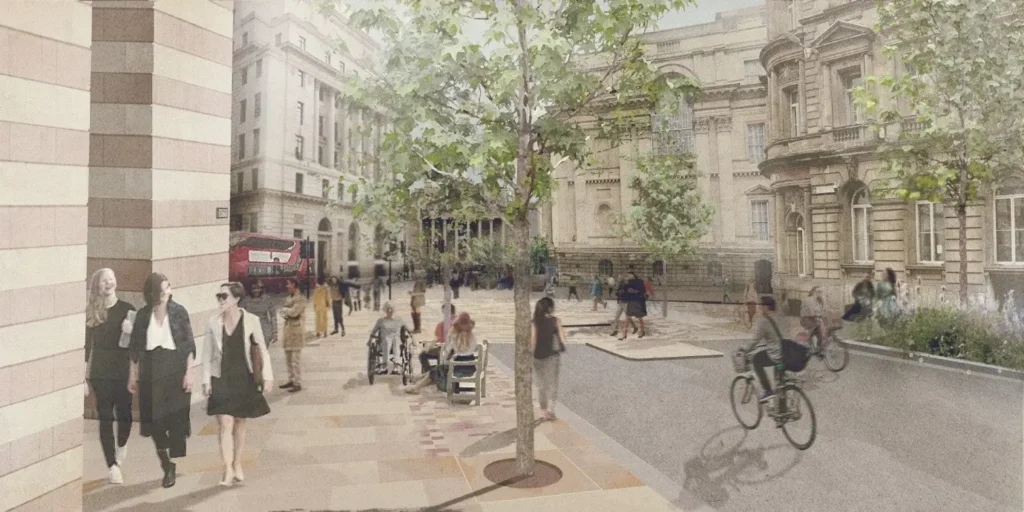
London Cool Streets and Greening
Compact vs. Sprawling: Which is Cooler?
Dense cities reduce car use (good for lowering emissions and excess heat), but they also have more paved surfaces and tall buildings that trap warmth. The best solution? A balanced approach that combines density with ample green spaces, smart materials, and climate-conscious design.
Pedestrian & Transit-First Zones: Cooling Without Cars
Not only do cars create pollution, but they also create heat. Cities that support walking, biking, and using public transit are typically cooler due to the reduced heat generated by motor vehicles.
- Portland has made parts of its city more pedestrian-oriented and included shaded walking paths and bike lanes.
- London’s Low Traffic Neighborhoods (LTNs) program involves limiting access to residential neighborhoods, reducing noise and traffic in the community, improving safety and keeping things cooler without heat-producing traffic, and lots more space for vegetation to be planted.
Smart Cities, Cooler Cities: Technology to the Rescue
Climate Mapping and Heat Data Analytics
Cities are increasingly using heat mapping tools to understand where the problem is most severe and where interventions are needed the most.
- London’s Climate Risk Maps: The Greater London Authority uses GIS-based mapping to pinpoint urban heat islands and overlap them with vulnerable populations for smarter planning.
- New York City’s “Cool Neighborhoods NYC”: This program uses data and satellite imagery to identify high-heat zones and deploy targeted greening and reflective material strategies.
IoT Sensors and Real-Time Monitoring
The Internet of Things (IoT) is making cities smarter and more responsive to changing weather conditions.
- UK’s Urban Observatory in Newcastle: The UK’s largest sensor network collects continuous environmental data, helping city planners model heat distribution and test cooling interventions.
- Boston’s Smart Streets Pilot: Sensors embedded in roads and lampposts collect real-time data on temperature, humidity, and pedestrian traffic.

Boston’s Smart Streets Pilot
AI and Predictive Design
AI can help architects and city planners simulate urban heat outcomes and optimize designs before construction even begins.
- Tools like Autodesk Forma and Climate Studio allow early-stage urban planning models that account for solar radiation, shade, and airflow.
- In the US, firms are now using AI to plan neighborhoods that maximize passive cooling and minimize energy loads.
How Governments Are Pushing the Cool Agenda
Governments at all levels are beginning to recognize urban heat as a climate justice issue, which affects low-income and marginalized communities the most.
Heat Action Plans
- London Environment Strategy (2018): Includes a comprehensive plan for reducing UHI by increasing green cover, setting building performance targets, and embedding climate resilience into urban policy.
- Los Angeles Cool Neighborhoods Program: Focuses on painting streets, planting trees, and installing cool roofs in heat-vulnerable zones.
Building Codes & Incentives
- UK BREEAM Standards: BREEAM encourages design features like solar reflectivity, passive cooling, and green roofs. The Mayor of London’s “Urban Greening Factor” requires developments to include a minimum level of greenery.
- US LEED & WELL Certifications: Many US cities offer fast-track permits or tax incentives for green buildings that meet high cooling and sustainability standards.
Building Codes and Incentives
Zoning & Land Use Reforms
- London’s “Low Emission Neighborhoods” (LENs): Reduce vehicular traffic and integrate environmental improvements, including tree planting, pocket parks, and permeable pavements.
- Portland, Oregon’s Green Factor Ordinance: Requires new developments to meet green infrastructure benchmarks.
Community and Equity in Design
Technology and policy serve a useful purpose, but the muscle and heart of any cool city is its people. Community engagement guarantees that solutions are both effective and inclusive, and equitable.
Cooling Centers and Community Resilience
- London’s “Good Thinking” Initiative: Initiative to promote help-seeking behaviors and awareness for residents’ mental well-being during extreme weather events, including heat waves.
- NYC Cooling Centers: A network of public places with air conditioning (e.g., libraries, community centers) that are opened during heat events, especially in identified underserved areas inevitably defined by historical systemic oppression or current wildly affordable housing circumstances.
Community-Led Urban Greening Projects
- Greening Grey Britain (UK): In this campaign, citizens are asked to convert paved front gardens into green spaces.
- The 10-Minute Walk Campaign (US) of Trust for Public Land: it seeks to keep every urban resident from being farther than 10 minutes walking from a green space.
Equity-Centered Design
In terms of cooling strategies, we must first consider those most at risk, including the young, elderly, workers in exposed occupations, and low-income communities.
• In New York, the Heat Vulnerability Index (HVI) is used to allocate investment for cooling infrastructure to the neighborhoods that need it most.
• In the UK, councils are increasingly using equity frameworks to guide tree planting and public realm improvements in those communities with the highest needs.
Conclusion
Urban heat is not just a summer pain, but it’s a growing public health hazard, an economic challenge, and a climate justice issue affecting millions of people in the UK, the US, and other parts of the world. As we have seen through the series, the solutions are myriad: plant trees, set up green roofs, apply high-tech surface materials, employ smart data from cities, and engage in equitable policymaking.
But if anything is obvious from this discussion, it is that no solution works in isolation. Layered strategies—some natural, some artificial, some top-down, some bottom-up, some very hands-on, and some distant—must come together to make the sustainable, cool city a reality, transforming the architecture of design-build-live.
With reflective roofs, urban designs, real-time heat mapping, and community-initiated greening schemes, cities such as New York, London, LA, and Portland demonstrate that it is possible and necessary to reduce urban heat.
That said, while governments and tech innovators provide a backbone for the movement, a citizenry in the know, businesses that act out of passion, and designers and architects who uphold their responsibilities determine whether the movement will succeed. The fight against urban heat is both technical and civic.
Urban cooling starts at the neighborhood level, but it ripples out beyond that. Be it the transformation of a single rooftop, the rechoreograph of a city block, or the advocacy of a nationwide climate policy, every single act contributes to an approach for a resilient and livable future.
Let’s make it happen. The cooler city is not a dream; rather, it is a design challenge that we can solve on account of together.
Frequently Asked Questions
How do green roofs and walls help cool cities?
Green roofs and walls work by providing different layers of vegetation that enable natural shading and evapotranspiration-the process by which plants release water vapor-which lower the temperature of the air surrounding the roof and reduce temperatures of rooftops by as much as 30 to 40 percent, and entail added benefits such as clean air, stormwater management, and biodiversity.
Are cool pavements and reflective materials effective?
Cool pavements and reflective coatings are shown to be able to decrease surface temperature by 10 °C or higher. In urban hot zones like Los Angeles and Phoenix, the application of these reflective coatings on pavements and roofs has demonstrated a decrease in localized temperatures, allowing heat to escape and reducing the demand for cooling energy in buildings, thus lessening the overall heat island effect while increasing comfort.
How does technology help in urban cooling strategies?
Technology is growing in importance, using smart sensors, AI modelling, and climate mapping tools. These technological innovations offer cities the ability to monitor current temperatures, identify hotspots, and even more effectively plan for interventions to provide cooling relief. For example, predictive simulations allow architects and urban planners to visualize through jolts of wind how to place buildings to enhance natural airflow and enhance shading, before any structure or project is even constructed.
How can individuals contribute to reducing urban heat?
Everyone can get involved! Residents can grow trees, use reflective paints on roofs, lower and/or mitigate the amount of impervious surfacing on their property, and help foster urban greening initiatives in their area. Supporting policies that are good for the climate, and getting involved with community projects like pocket parks or cooling center programs, makes a difference, especially in neighborhoods that are vulnerable to heat!