Navigating the UK Housing Crisis with Modular Construction—Part 1
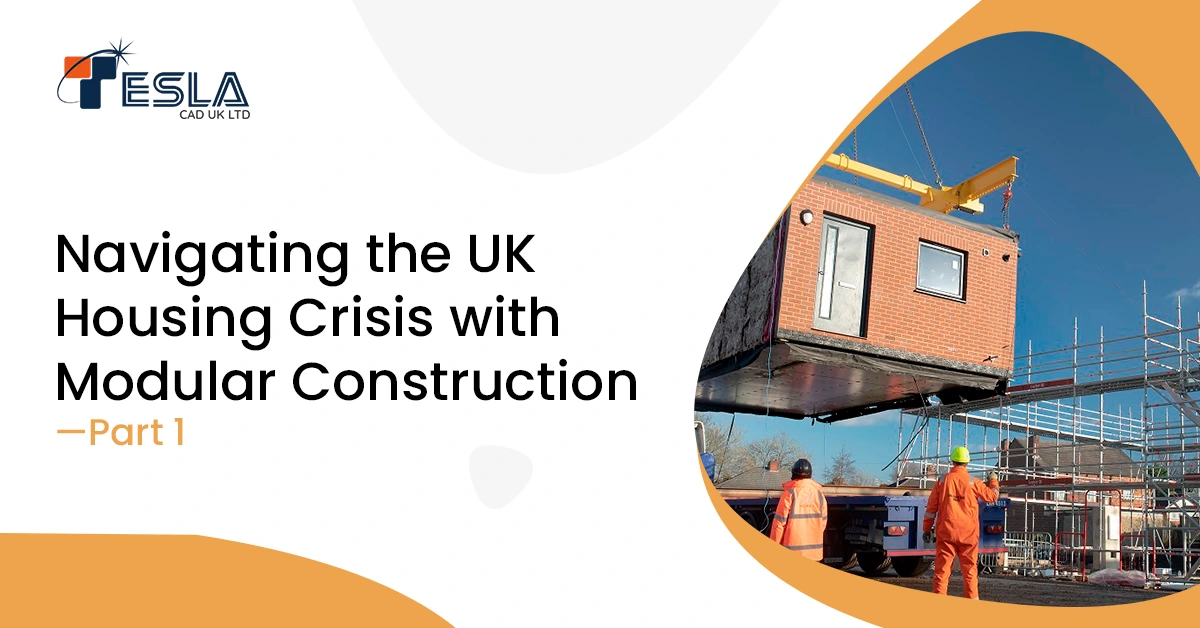
This is one of the worst housing crises in the United Kingdom in recent decades. Increasing property prices caused by rising population and land shortages, as well as the slow traditional building technique, have resulted in a situation where the supply just fails to keep pace despite the high demand.
As governments, developers, and communities are trying in vain to find ways out of the problem, one invention is taking hold as a highly efficient solution: Modular Construction.
Modular construction also facilitates faster construction time, greater quality control —often enabled by digital BIM—lower costs, and more flexibility because it is built with factory-built modules, which are constructed on the site in an assembly way. In its efforts to bridge its housing gap, modular building could become the answer to building more homes faster and on the scale needed.
The UK has a backlog of approximately 4.3 million missing homes that were never built, and would require building 442,000 homes per year for the next 25 years to tackle this deficit. This shortage has driven house prices to average 8.6 times the average income, nearly doubling from 4.4 times in 1999— SOURCE
In this blog, we will discuss:
- The reasons that led to the UK housing crisis
- Module construction: How it is done
- Advantages and disadvantages of using modular practices
- UK-based modular housing examples
- The modular construction future in the solution of housing shortages
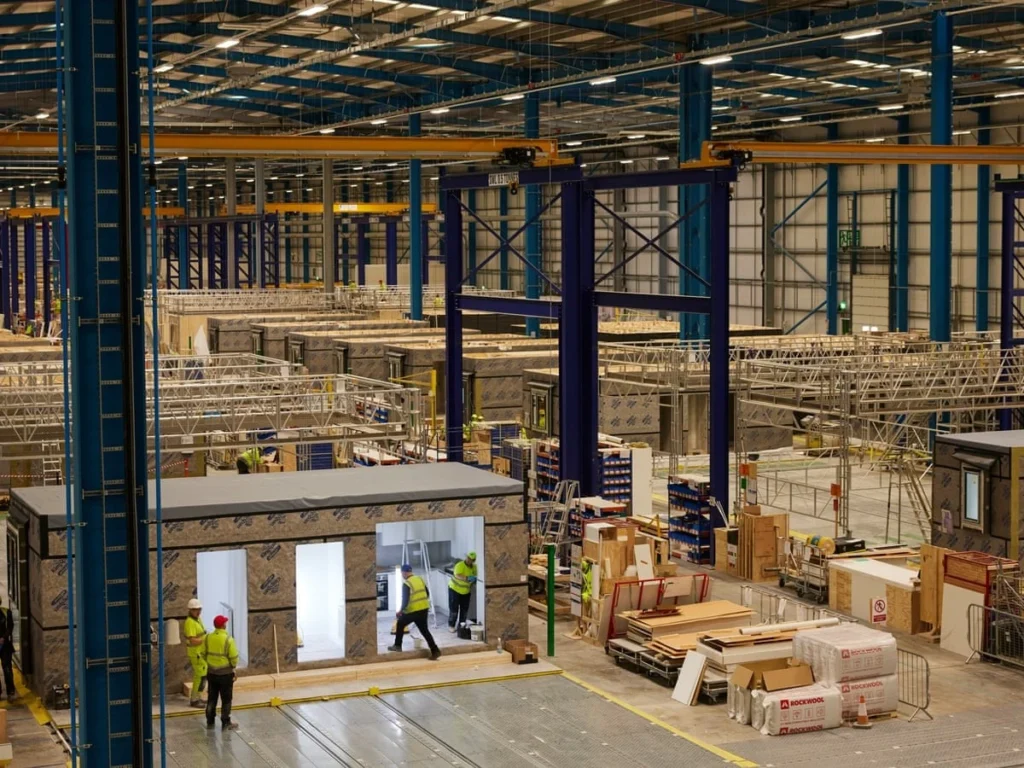
Modular construction
Understanding the UK Housing Crisis
Before we dive into modular solutions, it is important to understand the roots of the UK’s housing crisis.
Growing Population
- The population in the UK has been increasing slowly, and the current population stands at over 67 million.
- The developments are highest in the urban centers like those in London, Manchester, Birmingham, and Leeds.
- In the cities, the demand for cheap houses has been climbing, straining the supply of scarce land and resources.
Supply Shortfalls
- Government estimates suggest the UK needs around 300,000 new homes per year.
- In most years, actual housing delivery falls far short of this target.
- The backlog of unmet demand keeps growing annually.
Rising Land and Construction Costs
- Land scarcity in high-demand urban areas pushes prices higher.
- Labor shortages and rising wages increase construction costs.
- Materials costs have also risen sharply, especially post-Brexit and post-pandemic.
Planning Delays
- Complex planning approval processes delay many developments.
- Local community objections, environmental reviews, and legal challenges slow down project timelines.
- Many approved projects take years to start construction.
Affordability Crisis
- A lot of upcoming families and people purchasing a house are forced out of the market.
- There is also a short supply of affordable rental housing in most areas.
- Shortage of houses results in increasing homelessness and overcrowding.
Slow Traditional Building Methods
- The traditional lay-such brick-and-mortar construction is labor-intensive and weather-sensitive
- On-site construction can be hit by bad weather, labor strikes, and supply chain upset, resulting in a delay.
- The conventional techniques cannot crowd housing in large numbers within a very short time.
How Modular Construction Works
Modular building is a whole new way to construct buildings.
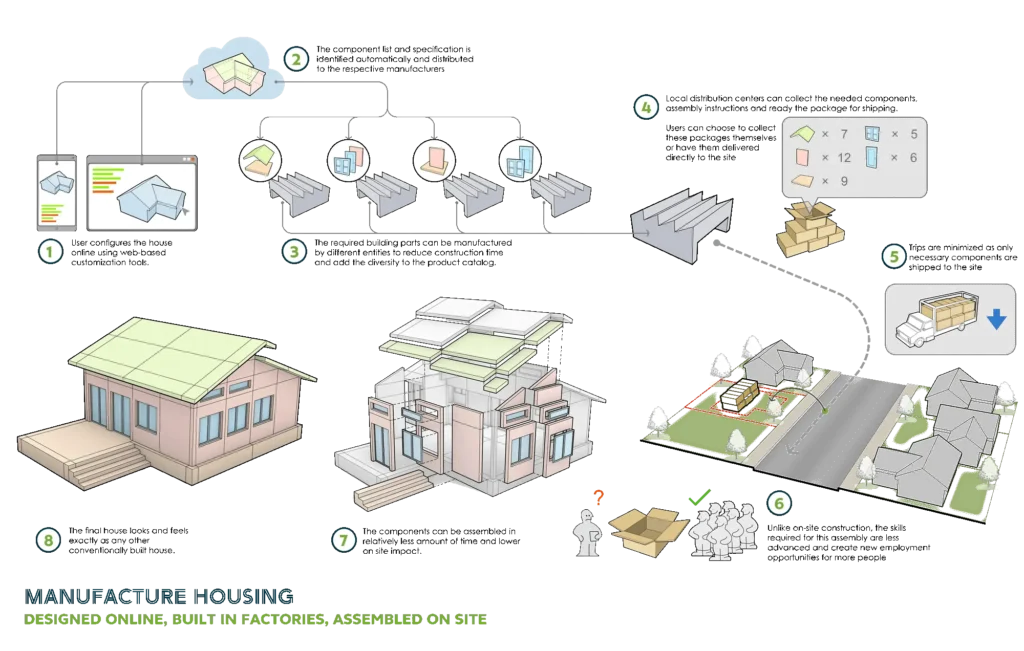
- Building modules are produced in a controlled factory setting.
- Each module contains structural members, walls, floors, ceilings, plumbing, and an electrical system.
- Modules are delivered to the building site and assembled like large building blocks.
- Once the modules are connected and finished on site, the final building looks very similar to a conventional build.
Modular construction can reduce overall construction waste by an outstanding 83.2% and consume up to 67% less energy compared to traditional building methods. Additionally, up to 96% of materials used in modular buildings can be recycled at the end of their economic life— SOURCE
Two Main Types of Modular Construction
Modular construction is changing the way buildings are done. They offer faster, cheaper, and greener buildings. There are two types of Modular Construction: Volumetric and Panelized Modular Construction. Each has its pros and cons, based on system complexity, final design, and delivery speed. Successful implementation of both approaches requires careful coordination between architectural, structural, and MEP systems.
Volumetric Modular Construction
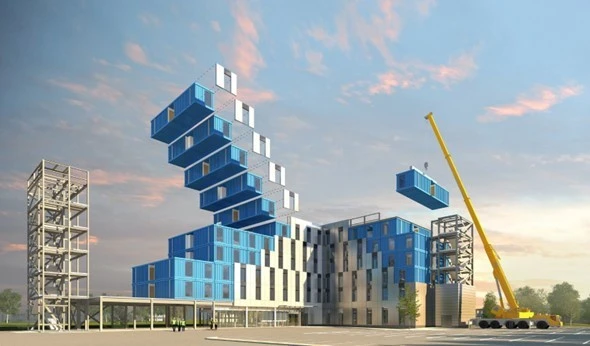
Volumetric Modular Construction
Volumetric modular construction has the potential to have whole 3D units built off-site, delivered, and assembled like building blocks on-site. It is best suited for buildings if speed and consistency of design, and quality are the goals.
- 3D, fully finished modules are built at the factory.
- 3D modules include bathrooms, kitchens, electrical wiring, and sometimes the finishes.
- Complete 3D modules can be quickly craned into the final position.
Panelized Modular Construction
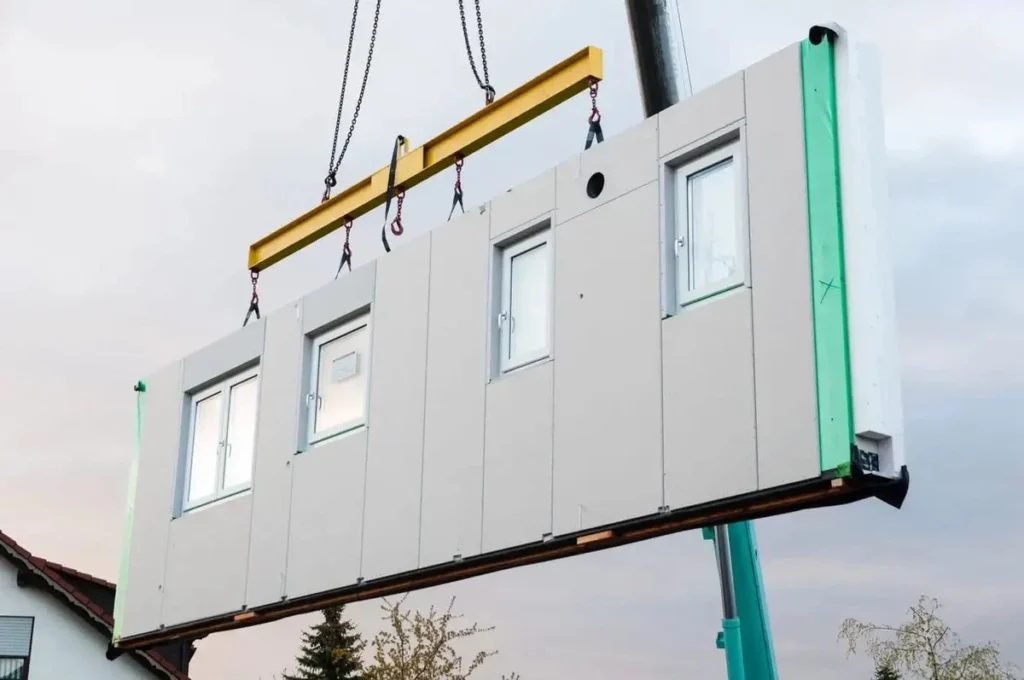
Panelized Modular Construction
Instead of building whole complete 3-dimensional units, panelized construction is where the building is constructed in flat pre-assembled panels off-site, and the panels are transported to the site to be put to assembled and erection. The flexibility in dealing with the pieces and modifying the design is possible in this process.
- Flat panels (walls, floors, roofs) are only built in the factory.
- Flat panels are assembled on-site to give the completion of the building structure.
- Panelized modular construction gives more flexibility in combining the assembly than volumetric modular construction.
Key Features of Modular Construction
A more recent approach to construction is modular, which is a fast, green, and detail-oriented building. Because modular construction brings most of the construction process into a factory environment, the building process can be accomplished with greater quality and efficiency compared to the traditional way of building.
Features of Modular Construction

Precision manufacturing
Building components utilizing advanced machinery and digital tools means components are built the same every time, and there is less opportunity for human error.
Controlled indoor manufacturing
You can avoid construction delays which is caused by bad weather conditions and gain more control over safety and working conditions.
Repeatability
Using standardized methods and processes, you can deliver a similar quality on every modular component or panel.
Faster assembly
Because major components are already constructed, the work that needs to be carried out on site is decreased, speeding up the project time.
Lower environmental impact
Controlled environments in factories allow for better management of physical resources leading to waste resource-controlled environments in factories allow for better management of physical resources leading to waste minimization and sustainability.
Why Modular Construction Fits
Speed of Delivery
- Modular buildings can be delivered 30 to 50 percent faster than traditional construction.
- Factory production continues regardless of the weather.
- Simultaneous site preparation and module manufacturing shorten total project timelines.
Cost Savings
- Reduced labor costs due to factory automation.
- Fewer costly delays from weather, materials shortages, or site conditions.
- Standardized designs lower engineering and design costs.
Quality Control
- Factory environments provide consistent conditions for construction.
- Precision tools and automation improve build accuracy.
- Rigorous quality inspections reduce defects.
Sustainability
- Modular construction typically generates less waste than on-site building.
- Improved material efficiency lowers carbon footprints.
- Factory production allows for better recycling and resource management.
- Transport and site disruption are minimized.
Safer Working Conditions
- Controlled factory environments reduce exposure to hazardous site conditions.
- Fewer accidents occur compared to outdoor construction sites.
- Improved worker health, safety, and productivity.
Design Flexibility
- Modular homes can range from single-family houses to high-rise apartment blocks.
- Modules can be customized for appearance, layout, and finishes.
- Adaptable to different urban and suburban environments.
Potential for Mass Production
- Factory production scales easily to high volumes.
- Enables rapid delivery of affordable housing at a national scale.
Projects using modular construction can be completed 30-70% faster than traditional builds, with some achieving completion in just 50% of the time of conventional methods. This speed advantage comes from simultaneous site preparation and off-site module fabrication— SOURCE
Besides solving the short-term housing needs, modular construction is also transforming the perception of houses in the UK. Modern modular homes are now characterized by sleek design, high standards of sustainability, and, particularly, the ease of integrating advanced technology that was previously perceived as being temporary or of poor quality. This change of attitude is not only altering the attitude of the consumer but also attracting more attention from developers and government agencies keen on achieving the housing numbers in minimal time with minimal hassles.
Conclusion
With its pace of construction, efficiency, and ability to maintain quality standards, modular construction is showing itself to be a solid solution to old building processes, and the UK housing sector needs a major improvement in this area. Although it is evident what this can become, this is not where the story ends. Part 2 will examine practical examples of modular housing initiatives in the UK, technologies behind this new trend, governmental incentives for the new generation of house building, and the issues that remain to cause a paradigm shift in the modular housing revolution.
What are the differences between modular construction and the customary ways of building?
In contrast to conventional on-site labor-intensive weather-dependent construction, modular construction involves products manufactured under controlled factory conditions as standards or modules; this minimizes delays, increases accuracy.
What are the principal kinds of modular building?
One comes in two forms:
- 3D volumetric modular construction: fully constructed 3D modules are fabricated off-site and then assembled on-site.
- Panelized modular building: Standardized panels (walls, floors, roofs) which are produced using an alternating site process and joined on-site.
Why should modular construction serve the UK housing crisis?
It enables faster, lower-cost, scalable construction of homes– and can help mitigate the difference between housing demand and supply in the UK.
Is modular housing green?
Yes. Modular construction reduces wastage of materials, enhances energy-saving, and contributes to the net-zero carbon agenda of the UK since it uses manageable production procedures and eco-friendly resources.