
ISO 19650 and RIBA: Key Differentiators

Introduction
You work in architecture, engineering, and construction; therefore, you have heard about ISO 19650 and the RIBA Plan of Work. What, then, are they exactly, and how different can they be from each other? Both appear to be about construction and BIM project management, but their purposes differ.
So, simply put:
- It is an international standard dealing with information management for BIM projects established by ISO 19650. It is a structured approach to managing project data for excellent partnerships among teams with the least miscommunication.
- The RIBA Plan of Work has instructions for a construction project- from concept design through operation and maintenance.
- ISO 19650 describes how to manage BIM data and workflows, while RIBA describes a structured process for the execution of architectural and construction projects. The two frameworks can coalesce in BIM-based projects; however, understanding their difference is a priority for AEC professionals, BIM managers, contractors, and project stakeholders.
Overview of ISO 19650

ISO 19650
What is ISO 19650?
ISO 19650 is an international standard that helps in Information Management. It grew from the initial PAS 1192 standards of the UK and has now been widely applied as a good practice for information management in construction projects.
- Work collaboratively in the CDE.
- Manage and distribute BIM data across different disciplines.
- Provide project stakeholders with the right information at the right time.
- Reduce errors, rework, and data loss.
ISO 19650 is not concerned with the design stage or construction process; it is about getting information from one hand to another as it flows across the project life cycle.
Key Components of ISO 19650
To get a better understanding of ISO 19650, let’s break down some of its core components:
Common Data Environment (CDE)

Common Data Environment (CDE)
The central and cloud-based structure where all BIM-related data are stored, maintained, and shared. One may picture this as the “Google Drive” of a construction project where everyone has access to the most recent information.
Information Requirements (OIR, AIR, PIR, EIR)

Information Requirement
ISO 19650 specifies various types of information requirements so that only relevant information will be collected and used:
- Organizational Information Requirements (OIR) – include high-level data needed by asset owners.
- Asset Information Requirements (AIR) – BIM data required to manage an asset.
- Project Information Requirements (PIR) – specific data required for a project.
- Exchange Information Requirements (EIR) – key BIM deliverables expected from project teams.
BIM Execution Plan (BEP)
It is an important document that defines how BIM will be helpful in a project. It includes team roles, software protocols, and collaboration strategies.
Responsibility Matrix
It defines who is responsible for what in BIM data management, avoiding confusion among teams.
How ISO 19650 Standardizes BIM Workflows
Construction projects have multiple teams, disciplines, and software platforms. It often leads to information confusion. It helps by providing a structured system for managing data.
- One source of truth (CDE)—No more missing or stale files.
- Clearly defined roles for stakeholders—All know their roles.
- An efficient process for design coordination and clash detection.
- Easy integration in platforms like Revit, Navisworks, and Autodesk Construction Cloud.
Read More
What is the significance of Open BIM and Closed BIM in Construction Industry?
Who Uses ISO 19650?
It isn’t just for BIM managers. It’s used by various professionals in the AEC industry, including:
- Architects & Engineers – To ensure their designs align with structured BIM workflows.
- Contractors – To manage project coordination and avoid costly rework.
- Owners & Facility Managers – To maintain accurate digital records for asset management.
- BIM Consultants – To ensure projects comply with global BIM standards.
Overview of RIBA Plan of Work

RIBA (Royal Institute of British Architects)
Source: https://www.architecture.com/
What is the RIBA Plan of Work?
RIBA Plan of Work is a structured project delivery format utilized mostly in the UK construction sector. It is a setting of the Royal Institute of British Architects. It operates from the concept stage right up to all the stages of design and documentation needs and delivery to completion.
This is for project managers, designers, and architects who must plan and monitor progress at each stage of a project. In distinction to ISO 19650, the RIBA Plan of Work centers on:
- Project timelines
- Design phases
- Construction execution
- Operational handover
Key Stages in the RIBA Plan of Work
The RIBA framework divides a project into eight key stages:
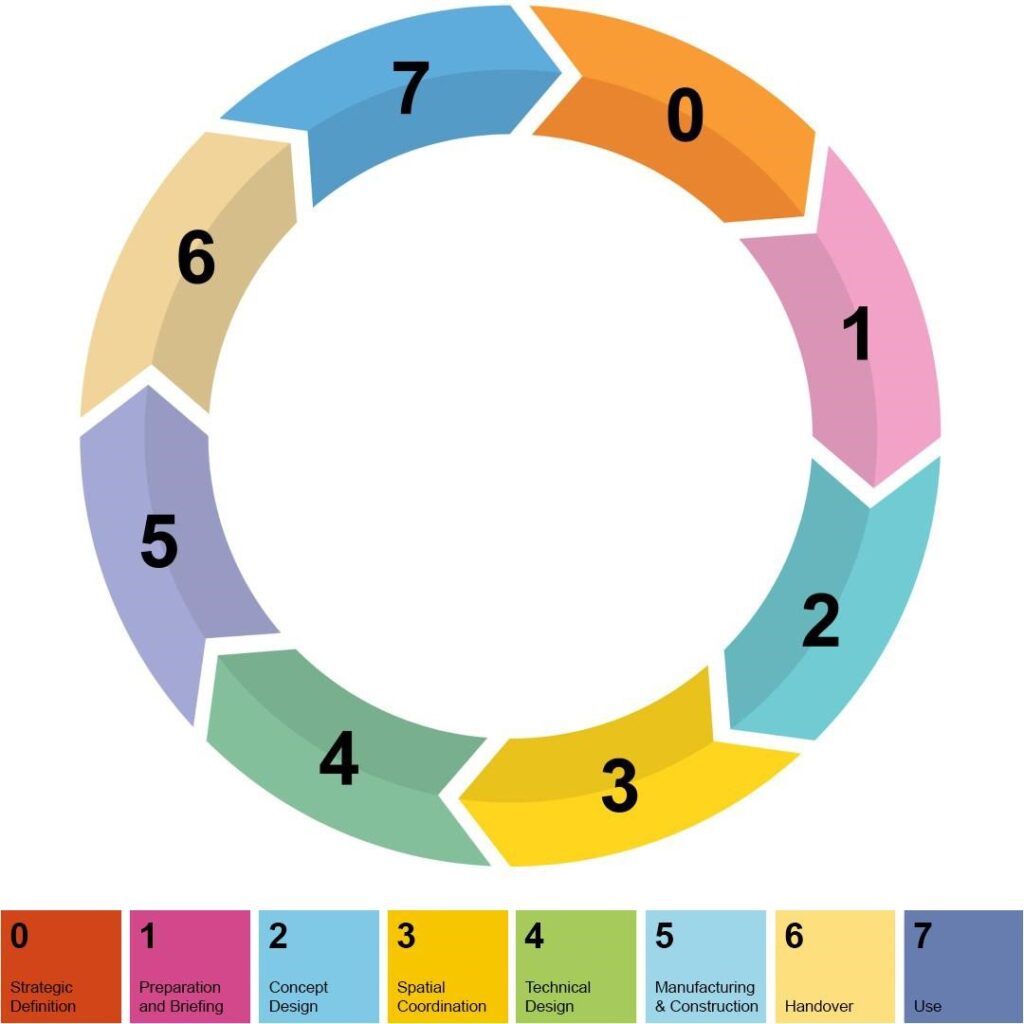
Key Stages of RIBA
Source: https://www.morsewebb.co.uk/
Stage 0 – Strategic Definition
- Establishing project objectives and feasibility
- Defining the initial project scope
Stage 1 – Preparation and Brief
- Developing the project brief
- Appointing key design team members
Stage 2 – Concept Design
- Creating initial design sketches
- Conducting feasibility studies
Stage 3 – Spatial Coordination
- Refining the BIM model
- Coordinating designs between architects, engineers, and consultants
Stage 4 – Technical Design
- Producing detailed construction drawings
- Preparing specifications for materials and systems
Stage 5 – Manufacturing & Construction
- Executing on-site construction
- Ensuring quality control and compliance
Stage 6 – Handover
- Transitioning from construction to building occupancy
- Ensuring all final checks and approvals are complete
Stage 7 – In Use
- Monitoring building performance and maintenance
- Managing facility operations
Did You Know?
Federated BIM models are a key method for coordinating complex designs involving architects, engineers, and consultants. Understand Federated Model BIM.
How the RIBA Plan of Work Standardizes the Architectural Workflow
While ISO 19650 standardizes data management, the RIBA Plan of Work structures project delivery. It helps:
- Architects plan their workflow efficiently
- Contractors follow a well-defined project roadmap
- Teams coordinate design, approvals, and construction stages seamlessly
Who Uses the RIBA Plan of Work?
Unlike ISO 19650, which is mainly BIM-focused, the RIBA Plan of Work is widely adopted by:
- Architects & Designers – To plan and structure their design process.
- Construction Managers – To track and manage project timelines.
- Project Stakeholders – To ensure alignment between design and execution.
Key Differences Between ISO 19650 and RIBA Plan of Work
ISO 19650 and RIBA share some similarities in initial inspection but deal with different project management aspects.
Purpose and Scope
- ISO 19650 deals with the organization, sharing, and coordination of BIM data throughout a project’s lifecycle.
- RIBA Plan of Work is a model of project delivery that describes what should be done at every stage of a construction project.
Focus on BIM Integration
- ISO 19650 is designed for use with BIM and seamlessly slots into the digital workflow.
- RIBA Plan of Work has BIM as an option, but it’s not specifically BIM-focused—it’s a more conventional project management framework.
Global vs. Local Relevance
- ISO 19650 is a globally accepted and adopted across the globe for information management.
- RIBA Plan of Work is used in the UK for managing construction and architectural projects.
Structure and Workflow
ISO 19650 structures the flow of digital information using:
- Common Data Environments (CDEs)
- BIM Execution Plans (BEPs)
- Standardized Information Requirements (EIR, OIR, AIR, PIR)
RIBA Plan of Work:
- Strategic Definition (Stage 0) → Concept Design (Stage 2) → Construction (Stage 5) → Handover (Stage 6) → In Use (Stage 7)
Stakeholder Responsibilities
- ISO 19650 is for facility owners, contractors, and BIM managers for managing data workflows.
- RIBA Plan of Work is used by architects, designers, and project managers.
How ISO 19650 and RIBA Can Work Together
Having established their differences, the question is: Can they be used in tandem? Of course! By integrating ISO 19650 and RIBA, one can develop an extremely streamlined design and information management.
Here’s how they complement each other:
RIBA Defines the Stages; ISO 19650 Defines the Data Flow
- RIBA Plan of Work provides a clear roadmap of what happens at each stage.
- ISO 19650 helps in structuring, sharing, & managing data correctly in each stage.
ISO 19650 Supports BIM Integration in RIBA Stages
- Stage 2 (Concept Design) – ISO 19650 helps teams structure BIM data for early collaboration.
- Stage 3 (Spatial Coordination) – Clash detection and digital coordination follow ISO 19650 principles.
- Stage 4 (Technical Design) – ISO 19650 ensures the correct information is handed over to the construction team.
Better Collaboration Across Teams
- RIBA helps architects and designers manage the workflow.
- ISO 19650 helps BIM managers and contractors organize digital information.
- Together, they eliminate miscommunication and reduce errors.
Bottom line: Using both frameworks ensures structured project execution with seamless digital data management.
Challenges in Implementing ISO 19650 and RIBA Together
Although integrating these two frameworks can be beneficial, it isn’t always easy. Here are some common challenges teams face:
Misalignment of Terminologies
- ISO 19650 uses terms like Project Information Model (PIM), Asset Information Model (AIM), and Information Requirements (EIR, OIR, etc.), which is not necessary that it always match with RIBA’s design-focused stages.
Different Documentation Approaches
- ISO 19650 requires BIM Execution Plans (BEPs) and a Common Data Environment (CDE).
- RIBA requires design reports, specifications, and client approvals at every stage.
Lack of Training on Both Frameworks
- There are teams that know RIBA but not ISO 19650 and others that are ISO 19650-compliant but do not keep to RIBA stages. Without training, integration will lead to confusion, not efficiency.
Best Practices for Aligning ISO 19650 and RIBA
- Use a Common Data Environment (CDE) to align BIM data with project phases.
- Ensure BIM Execution Plans (BEPs) match RIBA stages to keep documentation consistent.
- Train teams on both frameworks to avoid misalignment between information management and project execution.
- Adopt ISO 19650 principles within RIBA workflows for seamless collaboration between designers, engineers, and contractors.
How Tesla CAD UK Can Help with ISO 19650 and RIBA Compliance
Integrating ISO 19650 and RIBA into your workflow doesn’t have to be complicated—especially with expert guidance. That’s where Tesla CAD UK comes in!
We offer specialized BIM services to help firms align their processes with both ISO 19650 and RIBA standards. Our services include:
- We help firms transition to ISO 19650-compliant workflows.
- Setting up CDEs, BEPs, and digital project structures.
- Ensuring RIBA Stages align with structured BIM workflows.
- Helping architects, engineers, and project managers work seamlessly within both frameworks.
- Assisting in aligning ISO 19650 documentation with RIBA milestones.
Reach Us Today!
Streamline your BIM processes with expert ISO 19650 & RIBA support. Contact Tesla CAD UK to learn more.
Conclusion
The construction industry changes rapidly, with BIM filing into the paradigm of digital transformation. To prepare for the change process, it is required by a framework that holds promise for a project’s efficient execution alongside the management of data.
More on this are ISO 19650 and the RIBA Plan of Work. They serve two totally different functions and are not to conflict with another, as is usually assumed.
Findings from the blog:
- ISO 19650 consists the structuring of information, its sharing and management, in BIM procedures. Its proposal is that all data project-wise is organized in reduction of ambiguity and man-errors and better efficiency.
- It is a RIBA Plan of Work that guides a stepwise process in delivering an architectural project, defining what is necessary at each stage, starting from the first concept until the operation of the building.
Why It’s Important to Align These Frameworks
- Architects and designers frequently operate within RIBA’s framework, with BIM teams and contractors working under ISO 19650 for data and collaboration.
- A properly planned BIM process in accordance with ISO 19650 helps the teams to access timely and correct information.
- RIBA gives a transparent timeline, which ensures teams remain on schedule and hand over projects within time.
At Tesla CAD UK, we specialize in helping AEC firms transition to ISO 19650-compliant BIM workflows while ensuring their projects remain aligned with RIBA guidelines. Our expert team can assist you with:
- ISO 19650 adoption and compliance
- BIM coordination and model validation
- Common Data Environment (CDE) setup
- Training teams on integrating ISO 19650 with RIBA workflows
- Project documentation and structured data management
Want to optimize your BIM workflow and ensure seamless compliance with both ISO 19650 and RIBA? Reach Tesla CAD UK today to transform your project management process for better efficiency, collaboration, and success!
Frequently Asked Questions
Is ISO 19650 only for huge projects?
No, ISO 19650 can be used irrespective of the size of any project. It is meant for information management, be it for a small residential project or a large commercial structure.
Do you need any software for ISO 19650 compliance?
Not necessarily, but using BIM software like Revit, Navisworks or Autodesk Construction Cloud helps in the smooth management of ISO 19650 workflows. It is very reasonable to adopt a Common Data Environment (CDE).
Is RIBA the Plan of Work specific to architects only?
No, although the terminology RIBA is generally regarded as architect-specific, the Plan of Work assists project managers, engineers, and contractors alike through the establishment of a clear timeline and structured workflow for the project.
What are the major benefits derived out of the global adoption of ISO 19650?
ISO 19650 enhances collaborative working, fewer errors, and improved efficiency while doing construction projects. Being an international standard, it heralds the way for a firm working in the global arena to have a uniform BIM workflow, thus facilitating the management and coordination of data.